

The book “Architecture in the Making” has finally been published by Springer. A long conversation with Rita Salamouni and Nicola Scardigno on architectural form. Thanks to Franco Purini and Joerge Gleiter for the beautiful introductions and to Matteo Ieva for the insightful afterword.
Foreword
A treatise in form of a dialogue – Franco Purini
Architecture as medium and expression of human freedom – Jörg Gleiter
CONVERSATIONS WITH GIUSEPPE STRAPPA
Space or art of Delimitation – Nicola Scardigno
Reading the Territory – Rita Salamouni
Afterword
Poetics of the era and formativity of architecture – Matteo Ieva
——————————————-
N.S. I’d like to start our conversation by talking about the relationship between reading and designing, one of the central themes of your way of understanding the work of an architect.
In one of your writings you define the technique of reading as the “art of the possible.”
By emphasizing this relationship, you seem to recognize in the use of reading the ability to reveal and interpret the aptitude for transformation of the built environment. In other words, the reading would coincide, somehow, with the project itself.
My question is the following: if the project does not derive from, but coincides with the reading, could it not constitute a limit on the designer’s freedom, forcing him to follow a process that will end up imposing its choices?
Could you tell us more about this aspect of your working method, quite unusual in a context in which the center of the architectural project seems to be creativity and invention? In other words, how does the individual judgment of the designer intervene? That same judgment which in your method, in my understanding, tends to manifest itself as a “critical distance” from the reality that is offered to the designer.
G.S. Let me begin with a brief premise. I believe that the architect, in the crisis conditions which we are experiencing, cannot but be biased and propose the truth he believes in. At the same time, he is aware that in the contemporary context, when the unity of things has been lost, this truth can only be partial and that there are many
others.
In other words, the architect should possess his own vision of the built world in which he places and gives meaning to things. This vision should not only contain the perception of what surrounds us. It should also contain the myth and utopia that allows us to detach ourselves from the daily contingent and explore new territories.
However, within this idea of the world we inhabit, expressing ourselves based on a personal point of view is not enough.
We need to scrutinize with the reason the process by which the built landscape was formed and could be transformed. This could be done through a reading that will inevitably contain the result of a pre formed vision. In fact, every reading in architecture is critical and contains the aptitude of the object to be interpreted. It also has the active intentionality of the reading subject.We must know that there are many truths, but that we can only own one.
Moreover, the partiality of which I am speaking is also concentration. While being conscious of the general context in which we operate, we should, critically, neglect some elements, so that others appear with the utmost clarity.
On the contrary, it seems to me that the architect nowadays is lost in an attempt to understand and share everything, ending up adapting to all the requests, which are those of the market. The proof is that today architecture criticism doesn’t seem to exist except as an organization of consensus for media circuits. In fact, the general condition of architectural culture is still that of postmodern relativism. It is immersed in the late romantic myth of subjective expression and creativity.
Let me explain myself better.
Of course, the architect’s task is to grasp the instances of his own time. This should not consist in “recording” the contemporary condition. Instead, it should be a biased oriented intelligence that seeks order in the built world by stitching together its scattered details according to its own unified design thinking, not embedded in the present.
Architecture understands the world by turning to the history and lives oriented to the future it designs. The present is the current condition that we need to change.
Many of the best-known works, which are supposed to represent the image of our time, seem to derive, rather, from an effort of mimesis, and are often a parody of the contemporary world. They constitute, in fact, the product of an acceptance proposed as inevitable, the adaptation to a condition of irresponsibility. Evidence of this disengagement is the obvious decadence of the monument theme, of the celebration of institutions as the result of shared civil values whose last true interpreter was the epic poetry of Louis Kahn.
But let’s start, as you suggest, from the most personal and difficult truth to communicate. Let’s talk about the identity between reading and design. I believe that things are exactly the way you put and describe them: this coincidence between two aspects of design work, which are generally identified as successive stages of a process, is a different way of knowing the built world. It tries to grasp from the object of study, not only the real characters, but, at the same time, the aptitude for its transformation. It contains a hope, a desire.
On the one hand, reading is, for the architect, a critical knowledge and cannot be neutral. It is purposive and contains an evaluation and a distinction. It does not precede the project; it builds it, informs it, indicates its possible future form. I understand the difficulty in accepting these considerations in a discipline in which the reading
(historical, topographical,morphological) usually precedes the design act in an oftenritual way. In fact, reading the built landscape that surrounds us is not a description through which we state the terms of the problem. It is the substance of the project itself. On the other hand, the project is a general form of knowledge, a reading. As architects, we know the world around us through the project which, in some way, contains our universe, our way of being on Earth. It encloses a “pre-form.” I believe that this notion explains many things: the pre-form is the condition within which we read the built environment, the substratum of our consciousness that makes every
reading, and therefore every project, individual and non-repeatable.
This observation runs through the entire history of Western thought in various ways: from Aristotle’s statement where the interpreter cannot “prescind from himself” up to the “pre comprehension” of Hans Georg Gadamer (the a priori meaning we attribute to things when we need to recognize them).
Hence the architecture I am thinking of is a “formative” architecture, based on formed and forming. Therefore, the design activity is a circular process. It begins with reality: in the infinite possibilities of change in the existing reality, we look for some common aspects, the general in the particular. Through the study and comparison of the phenomena, we abstract some (few) generative rules. We trace a finite series of principles capable of generating an infinite series of forms (not all necessarily realized or achievable).
We then go back to reality, which only accepts those forms congruent with the real context, and whose number is further reduced when the responsibility of the designer intervenes with his understanding of economic and social needs.
Moreover, when he operates, the architect’s aesthetic synthesis can only be personal, singular. Therefore, the general and common is “identified” and becomes unique, irreproducible and individual. In other words, I am convinced that our action should be placed in the great flow of transformations of the world we inhabit. We must seek the sympathy with things. In fact, for our small contribution to be useful to the transformation of the environment, it must contain a much distant and different way to design. This term has for me the literal meaning of inventing (from the Latin invenire, to meet), encountering new forms, in the study of the built universe, which may contain some fertile diversities or dissonances to cultivate.
Reading, as a critical representation of the builtworld, is also an individual attitude of the spirit. It is an art. As you said, it is the “art of the possible.” Understanding it as an opening toward the infinite possibilities that are offered to the way we perceive the world implies a study of the form (a morphology) that is anything but classificatory.
It should not be conducted with the tools of the entomologist, as if the universe built by man was governed by rigid and inescapable laws.
It is, on the contrary, a procedure that I would call “artistic.”
According to a late Romantic idea still widely practiced today, is artistic the manifestation of a feeling as an individual. However, what I mean by art is, instead, in the classical sense, the rule that presides over the act of transforming things, the τέχνη.
The project consists, as I see it, in the last stage of a reading process, the one where what is ends and begins what could be and what you want it to be. It is evident that giving form to the aesthetic synthesis that transcends construction is a task that involves the architect’s individual nature, his choices, and his poetic way
(the personal truth of meanings) of seeing things. But it also has to do with his responsibility, setting boundaries to his artistic freedom. In fact, we need to understand what this term means in architecture. The writer’s freedom is not to use words freely, without respecting the structure of the language (without which there is no communication) but, on the contrary, to know it so well as not to feel its burden in writing. And the same applies to the musician. Why shouldn’t it apply to construction?
Architecture, understood as a discipline, has its own character. It is a civil art, aimed at satisfying the need to represent a social context. It is an “inevitable” art: we may not see a paintingwe don’t like but we cannot avoid the reality of an architecture, of an urban space. This is why we are not allowed to guess through perception: we are required to deduce through reason.
This way of seeing things gives a different meaning to some established axioms.
On the basis of what I maintain, for example, the masterpiece is not the work that owes its value to the fact that it is totally new that it contrasts with what has already been produced. Themasterpiece is the individual (individual!) synthesis of a forming process, the one that expresses, in the fullest form, the spirit of a civil community in time and space. It is formed through shared principles; the unitary spirit that binds the dispersed detail to the totality of the organism.
A masterpiece is the work (very rare) that looks at the past with new eyes, concludes a process, and sows the seed to start a new one.
N.S. There is one aspect that is still not clear to me. I would like to understand whether in your work the reading of the built reality offered to the designer represents a “limit” or a “boundary.” That is, whether it constitutes an instrument of almost absolute value, by which the design outcome is strongly conditioned, or whether it is the center of a method that collaborates to the designer’s work by defining its contours open to multiple interpretations, establishing a “critical distance” with the object of study.
G.S. I believe that the essence of the architect’s work consists in the criticalreading of the built reality open to different design outcomes and to infinite aesthetic syntheses. As architects, we operate on the existing built landscape through “preforms.”
They are different for each of one us and constitute the individual condition of our consciousness through which we look at the world.
Let me start with a consideration on the contemporary meaning of what I am saying. In the crisis we are facing, I realized how statements like the ones I made may seem, inmanyways, out of date. This consideration is very comforting tome because I almost agree with nothing in what is being done in architecture today, such as the aestheticizing drift in which even ethics has become an ingredient of the spectacle, of the media circus that turns everything into goods.
“More ethics and less aesthetic” is a successful slogan, fed to a society of consumers, in which no one really believes. I therefore accept the outdatedness ofmy research and consider it a resource. Although there is no doubt that it is a component of it, the essence of architecture is not a subjective expression, communication or personal commentary on reality: architecture is reality.
I don’t know if this way of seeing things can be defined, as you said, as “critical distance.” Certainly, by the very nature of our work, the relationship with the matter to be transformed tends to be passionate and emotional. But, according to a still very current romantic tradition, it threatens to overlap with the civil role that the architect has in our society.
The antidote against the intrusiveness of emotion is dialectics, which forces the thought to alienate itself from its own beliefs, to put a distance between the author and what he produces, allowing ideas, in a continuous becoming, not to stiffen.
In this sense, the built reality as well as the landscape it offers to our perception, do not constitute a limit at all. They do not dictate laws or rules. According to Kant, the limit presupposes “space that is beyond,” which contains a whole world with its own order. However, the world around us is an open whole, where everything overlaps and coexists. Reading and designing, with the difficulties that this action entails, mean precisely this: unraveling the complexity of the whole by not isolating the part, understanding how the elements of the built landscape that surround us are complementary.
This allows us to not identify ourselves with the object of our study. I would say that the designer’s effort should tend to look at the built world with the detachment that allows him or her to understand places as a common good, in their historical development, with a kind of “critical empathy.”
This will allow us to overcome the pure perception of forms.
The form, which is at the heart of our craft, is not the surface that we grasp of things: it is the way in which a structure gives itself to our eyes, how we know, individually, even what we do not see directly. The seduction of appearance is one of
the great dangers of our work. That white house we see is part of a group of houses. But the white color is the visible property that we all perceive through the optic nerve.
However, the way in which it is part of a whole, an element of a society of houses (that is, the links that bind the objects), is not visible. It derives from experience, knowledge and reflection, that is, from the specific culture of the observing subject.
This necessary understanding of things should be clearly highlighted and does not necessarily mean, in the project, affinity: it can be translated into opposition, if circumstances require it. But even fractures and tears, when they are real, express a procedural drama, the extreme of sudden transformation, not the exhibition of the author’s feelings. I am thinking of the many centerless revolutions of contemporary production, the “discovery” of the theme of fragmentation of the contemporary city which has become a true literary genre.
At the opposite extreme, we find the absence of transformation, the identification of intentionwith what exists, itself part of a process. This is the most difficult reading. Perhaps the architect should learn that, at times, critically reading a place can also mean carrying out wise maintenance while basically leaving what has already its own function, beauty, meaning.
A few days ago, my friend Vincenzo Latina presented on Facebook the case of the splendid Baroque church of San Gennaro located in Capodimonte, Naples “before and after the care of the Archistar Santiago Calatrava” who turned it into a kind of seaside disco.
An extreme example, among many, which indicates how much architecture is a risky job, and often induces to the invasion of places. OurMinister ofCulture rushed to incautiously declare that “this experience,which mixes contemporary and baroque art in an unprecedented way, will have to show us the way.” Capodimonte church remains one of themany cases in which the collective feeling of inhabitants is trampled on, by the narcissism of the architect. How many buildings, historical and not, have in fact been turned into matter at the disposal of the designer’s ego, receiving the concordant consent of the “critics?”
Was there really a need to invade the magical territory of the Domus Aurea in Rome by a spectacular up-to-date intervention?Wasn’t the space in the SalaOttagona evocative enough, with all due respect to the media success of the studio that designed the work?
Perhaps it is necessary to explain that restoration is already a project and a transformation. And that, sometimes, even less is needed. I think we should rediscover the fascination and usefulness of the gaze that contemplates the reading of things in which no aptitude for transformation is recognized. “Is it really necessary to build a new public granary”—wrote Confucius 2500 years ago—“when the old one is still good and the new one will cost people a lot of sweat?” That granary actually possessed, like all things, not only a utility, but also, a magnificence of its own. The problem was that many, noted the master, did not know how to read it.
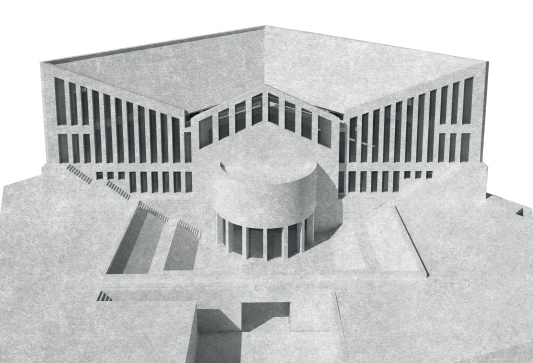 THE HERITAGE OF THE ROMAN SCHOOL OF ARCHITECTURE AND THE CANIGGIA’S NOTION OF ORGANISM
by Giuseppe Strappa
in: Gianfranco Caniggia Architetto, edited by Gian Luigi Maffei, Alinea, Florence 2003
The figure of Gianfranco Caniggia, as a scholar and architect, must undoubtedly be studied inside the general background of continuity with his own cultural area, whose heritage – extensively dilapidated by Italian post-war architecture – was driven as much by “survivors” who contributed to the formation of the Roman School of Architecture between the two wars (Fasolo, Foschini and Piacentini) as by Saverio Muratori.
Saverio Muratori’s fundamental role in the formation of Caniggia’s thinking is fully dealt with in another part of this publication.
Our intention here is to develop certain considerations, already disclosed at the Cernobbio convention in July 2002[1], about Caniggia’s heritage from didactic experiments conducted by the Roman School of Architecture between the two wars, based on history’s new centrality in built environment interpretation and design and the architectural swing-back, foreshadowing “redesign”, tooled by planners and implemented by the built environment’s forming processes, through which the notion of organism is actually transmitted as an “integrated, self-sufficient correlation of complementary notions with a unitary aim”.[2]
A great deal has been written, especially during the post-war period but also in recent times, about the conservative standpoints of the original Roman School of Architecture, generally considered “academic” in its meaning of pedantic submission to traditional design forms and rules: didactics not abreast of rapidly changing times and design contrary to the spirit of modernism, equivocally identified as avant-garde for some time.
In fact Giovannoni, Fasolo and Milani, innovatively followed by Muratori and Caniggia, were perfectly conscious of conditions induced by modernity yet, like all classic thinker, they interpreted avant-gardism as a loss of rules and fragmentation of the basic unity of knowledge, clearly acknowledging its compounding of problems. In architecture, these fragmentations coincided with the irrational destruction of established values with intellectualistic and, therefore, unruly abstract experimentation.
They were fully aware of the true conditions of the modern crisis and, also, how it was impossible to repeat the archaic unity of things that had enabled the historic continuity of civil experiences, building cycles and decadence of forms. They also knew that the world required new answers to up-and-coming, complex problems. Yet they did not agree – and this is where they differ from the Modern Movement’s pioneers and their followers – on the accepted meaning of the crisis, faithful adaptation to new myths and noting of the desegregation irreversibility of every shared and authentic language. Not to mention every style. However, in the wake of major reformers, they did not surrender to the apparent evidence of objects by interpreting the built environment not as it appears but, according to their own design ethics, making interpretation converge with a transformation hypothesis that gave meaning to the built environment, unifying in the “thought which became architecture” the conscience of countless phenomena which otherwise appear as simple, dispersed fragments.
Giovannoni’s intuitions, Muratori’s major territorial visions and Caniggia’s interpretations of the organic transformation of basic building into specialized building are interpretations that not only imply design but are, themselves, design from many standpoints.
In Caniggia’s thought, the interpretation of modern succession (of critical conditions resulting from bewilderment vis-à-vis repeated, extended area exchanges, from the internationalisation of critical design tools, from the generalized serialization of forms and from the arising of new production modes) joined a current of thought originating from the criticism of contradictions arising from the radical split between reading interpretation and construction generated by the loss of the synthetic, unitary idea of organism. Just in this radical split they recognised the formation of various tendencies in international modernity, starting from the beginning of the century.
Fully comprehending how modern architecture cannot be traced back to a single corpus of design theories and tools, synthetically individuated through a presumed common language, Giovannoni raised the issue as far back as the Thirties. He opposed militant propaganda who tended to debase an unitary idea of the Modern Movement by sustaining the existence of numerous, contradictory forms of modernity, individuating the topic around which opposite design principles revolved in the discord between analytical technical and intuitive artistic components and in its direct upshot, individuated by the unsystematic relationship between structure (in the sense of static-structural system) and architectural form. The parallel transformation process of its technique and aesthetical principles, which enabled continuous exchanges among complementary disciplines, ended during the 19th century when the thread of stylistic continuity was broken between building and form and the two terms “seemed to belong to an organism that had lost its physiological balance”[3].
Giovannoni accused the split between architectural “imagination”, eclectic building and, above all, modernism at the beginning of the century for the fall of the “principle of truth” that has always been, during the course of history, one of the ethical rules that architects were called to obey, as proven by modern Roman architecture, unsupportive of innovative trends such as liberty that proposed such an indirect relationship between interpretation and typological character of architectural organisms as to leave the study of façades to other disciplines as visual arts and industrial design. Giovannoni did not reduce the “principle of truth” to a simple cause-effect relationship between static-structural solutions and spatial-pattern upshots, by introducing the implicit relational – and not mechanical – notion that averages form and building and which Caniggia then developed out rightly in his exposition on “direct and indirect” interpretation forms of architectural organisms, specially in his second volume on basic building design[4]. To oppose the simplifications of positivist trends, Giovannoni provided an implicit definition of the notion of interpretation that actually seems to foreshadow Caniggia’s thoughts, establishing the principle that the foundation supporting architectural composition must not only have an “actual structural basis” as building rules provide precious means of expression in simple cases and, anyway, do not suffice in the most exacting applications. Structural nature must arise as a component or “general compositional sentiment” in the formation of the building’s general character, avoiding solutions that bare its body or even “display its skeleton”.
In fact, Giovannoni individuated the splitting of original design unity into various, specialized aspects of modern architectural thought by thinking about form and admitting how – in certain research series – indirect interpretability prevailed over direct interpretability of structural organisms,
The positivist line of thought was individuated in the sequence that originates in Schopenhauer’s assertions in Die Welt als Wille und Vorstellung on the disagreement between architectural weight and rigidity and that was developed with Viollet le Duc’s constructivist theories expounded in Entretiens sur l’Architecture and with Pugin’s assertions (considered, amongst other things, to disclose functionalist architectural interpretation) and ended with queries raised by new building experiments and by new materials answered by Modern Movement theoreticians, especially Le Corbusier in Vers une Architecture nouvelle, in aesthetical machinery and manufacturing terms.
Alongside this line of thought and in direct opposition to its apparent productive pragmatism, Giovannoni individuated a second set of theories that privilege (dimensional, geometric and chromatic) aesthetic rules actually linked more to physiology than to reason, an expected design principle. This line of thought was rooted in ancient theoreticians, who seemed to find new justifications in abstract art, true to the positivist meaning of architectural work, without any contemporary critic revealing its contradictions. Even though inexplicably Giovannoni – who had individuated in August Tiersch’s proportional theory the link between ancient treatises and modern design, does not exemplify the results of this different component of modernity in architectural practice – he evidently alludes to works such as Le Corbusier’s Villa Stein, where the town plan appears, free from any structuring reasoning, to exorcise the arbitrary nature of its façade composition by stating its hidden Muthesian derivation from Anglo Saxon picturesque tradition.
The start of modern interpretation of the expressionist series, in opposition to “formal and objective” aesthetics based on geometric rules – the third group of theories that was also latent in ancient and Renaissance treatises – was grasped by Giovannoni, especially in studies on the use of psychology in interpreting Wölfflin’s artistic work, while a fourth group of theories was acknowledged in the work of those who derived architectural forms from the environment, intended as much to be an historic context as the nature of the place, clearly raising the issue – which lasted right throughout the second half of the 20th century, especially during the seventies and eighties – of its relationship with area references, often simplified in the internationalism-localism combination.
This interpretation of modern architecture is evidently the disruption of shared, original organic totality and Muratori’s interpretation of modern succession – as it was expounded during the period that coincides with the first critical elaboration phase of Caniggia’s thought – in his first post-war writings and in lessons imparted at the Roman Faculty of Architecture at the end of the fifties, retrieved and published by G. Cataldi and G. Marinucci in 1990[5].
Yet, at the same time, Giovannoni admitted how the theoretical innovations that characterized the Modern Movement, albeit with unexpected results, were an attempt to overcome the late 19th century eclectic drift in an endeavour to rebuild a new full design form.
Antinomy between modernist theories and the structural procedure that Giovannoni acknowledged, amongst other things, in manifest rational architecture: in fact, he does not out rightly refuse rationalism “that sticks to the principle of necessity and sufficiency” but the “unreasonable” rationalism that ends up by splitting design issues into structural “exaggeration” on the one hand and functional exaggeration on the other; the two sides end up by sticking to the same formal arbitrary principles of ecleticism, including in design unity the remaining spontaneous component that enables art to be spoken about as “presumptive intuition” or “an early form of knowledge”[6].
The same fragmentation of other modernistic trends hid behind recent developments of rationalism: the technically exalted truth principle was actually contradicted by the lack of a general shared order and of a discipline that freed design from the changeability of fashions and from extemporary invention.
Saverio Muratori, studi per il Palazzo della Democrazia Cristiana all’EUR, s.d.

Right from initial syntheses during the forties, Muratori’s thought seems to extensively resume and develop certain issues raised by Giovannoni, not only by basically acknowledging lacerations in modern succession and including modernism among eclecticisms (environmental aestheticism) that had lost the order governing the unitary formation of architectural organisms but also reconsidering, more generally, the linguistic fragmentation that preceded the first world war as the origin of the crisis in modern language. Despite its moderation as compared to the excesses of 19th century eclecticism, this phase was an ambiguous passage in the history of architecture; disbelieving linguistic unity, it ended up by being an “anti-stylistic” period”[7].
Contrary to superficial, misinformed historiography that dichotomously separated academics from innovators, Giovannoni criticized modern and, therefore, perfectly updated, fertile internationalism, consciously included in the contemporary debate. In other words, it is not a question “on the one hand of persons ignorant of the European cultural picture”, as Caniggia observed – nor of informed participants. If anything, the apparent independence of the former from diatopic architectural developments and the intentional upshot of their attention to the relative autochthony of experiences and of their continual reference to local participation compelling continuous critical choice to exclude modes and behaviours considered out of character with the place itself, to prefer outside experience and to assume facets in character with the Roman built environment”[8].
In keeping with this critical series developed between the two wars, Caniggia also accepted the basic historic need for the Modern Movement, admitting how it strove to bridge – despite contradicting aforementioned specializations – the gap between the interpretable form of buildings and aggregates and their relative building and fabric types: especially in basic building. The imitation of interpretability originating from specialized 19th century building was sometimes successfully overcome by part of modern architecture’s endeavour to swing-back to a comprehensible relationship between building (orientation of building parts, ceiling texture and layout of bearing walls) and external interpretability (hierarchization of apertures and expression of dwelling units in shells).
According to critical intuition that was already latent in Giovannoni’s thought, the Modern Movement was mainly accused of not having taken forming processes into account and, therefore, of professing aestheticism and being individualistic. However, these processes continued to operate also in wider spread modern architecture, in a sort of area inertia that could not be completely eliminated. As in the case of Oud’s row houses in Kiefhoek, where façade walls are evidently not bearing and strip aperture seems to be rooted in the local language and in the flexible wooden origins of the Dutch area – despite its out-of-character flat-roof solution – or in the case of Fisker’s block in Copenhagen where obsessive holing seriality, indifferent to the dimension of underlying rooms, is made to originate from its wooden trellis construction and continual windows, even though the corner solution right around, more pertinent to masonry areas, seems to be out of character with local tradition.
The innovativeness of the line of thought leading from the Roman School, which formed between the two wars, to Caniggia, can be assessed by comparing it to surrounding conditions in the context of the international debate on architectural design tools. If related to European schools’ contemporary interpretation of disciplines such as the History of Architecture or Restoration, for instance, it is worth mentioning the Roman School’s great effort to renew them by restoring monuments, not just as a constituent part of architects’ culture but also as a way of extracting linguistic rules from the series of texts handed down by history.
Caniggia developed, innovated and systematized this heritage by introducing the issue of not only comprehending cultured monumental language but also basic building “dialect” to such an extent that he almost founded a new discipline – which becomes increasingly valuable the more we consider the cultural climate in which his didactic and design experiments were conducted – countered, with rare major exceptions, by confused reinterpretations of the past, intended as a morphological repertory for looting, or spent revivals of the Modern Movement’s principles[9].
In order to get to the bottom of this discipline, consider the founding role played by the teaching of history, continually updated by Gustavo Giovannoni and then Vincenzo Fasolo at the Roman School, during the pre-war period. In fact, this teaching was imparted not only though institutional courses on the History of Architecture but also through a real “didactic organism” necessarily pooled with courses such as Stylistic and Structural features of Monuments, imparted for many years by Guglielmo De Angelis D’Ossat as from 1937, basically true to Gustavo Giovannoni’s views and in the conviction that restoration, like all architectural operations, possesses inevitable critical and, all round, design material. This didactic organism was fundamentally boosted by Monumental Restoration teaching, imparted during the first year of the Regia Scuola di Architettura in via Ripetta in 1920-21, before it became a university faculty, by Sebastiano Locati, a teacher who played a brief, yet significant, role in linking up with Lombard research and the antecedents of Boito, who had taught him. Trained at the Brera Academy and then at the Milan Polytechnic School and an authority on Roman monuments’ organic features by directly surveying buildings, Locati proposed restoration based on rules analogically deducible from a stylistic comparison between synchronic works: restoration considered by his technical and artistic training as the synthesis of all architectural disciplines, by interpreting planner roles similarly to Giovannoni. This teaching was then taken over by Giovannoni himself for twenty years until he stopped lecturing in 1943, testifying to the discipline’s founding role in the Roman school’s more general didactic design context.
For Giovannoni, didactic restoration of the work’s original organicity by interpreting typical transformations was actually a tool not only oriented towards restoration but, more generally, towards comprehending the forming processes of architectural organisms. When faced with the problem of restoring a work of architecture, Giovannoni intentionally proposed – moving away from Viollet le Duc-style back-swings and with a surprising assertion of principle that, however, was perfectly consistent with his theoretical assumptions – that works could never actually be completely restored (note the affinity with Caniggia’s thoughts).
Therefore, it is clear how restoration was not just intended as study and safeguarding of the document’s historic and artistic aspects but also as a purely design operation which, like all design, is critical modification of the built environment and also restoration of the qualities of the organism intended, Caniggian style, as individuated type.
In fact, Giovannoni realised the specificity of the method used by architects to research other disciplines and how architects, “when they apply methods, fit for other arts, to architecture, also become amateurs and often presumptuous.”[10] With this background, history could not be considered as a tool of knowledge with independent aims but ended up by foreshadowing “operational history” that was forcefully proposed by the Muratorian school during the post-war period and whose capacity, especially in the field of the recovery, conservation and safeguarding of historic fabrics, restoration culture – as Gaetano Miarelli courageously called it – “was unknown or incomprehensible to it, let alone exploitable by it.”[11]
Lastly, drawing disciplines were to assume a vital function in the teaching of the history of architecture at the Roman Faculty[12]. In fact, drawing became not merely a communications and graphic transmission tool, as in schools for applied engineering, but above all a means of research and knowledge, linking history’s role to that of design[13].
As a result, according to a thesis that Giovannoni had developed some time back, architectural research was supposed to be “unitarian”, i.e. examining the phenomena that structurally and aesthetically combine unitarily to form the organism, and in terms of practical spatial and financial requirements, of external expressions and of its relationship with civilization and social conditions”[14].
The issue of teaching unity as essential to the organic synthesis expressed by design had already been raised by Giovannoni in 1907 with his proposal of the “complete architect”, who would have been trained though coordinated fields of study, each oriented towards “complete artistic training”: technical training “comparable, albeit in a narrower field, to that of civil engineers; independent study training produced by general culture “that could only be provided by a university”, and in-depth knowledge of architectural and art history”[15]. An idea resumed by Giovannoni on various occasions with his “complete architect” proposal, judging that – amongst advocates of “architecture as merely a branch of building science” and of “architecture as always, and above all, art with a capital A, which cannot be compressed by too many other notions” – architects have to be artistic experts who have acquired specific qualities not through “independent notions” thrown together but as expressions of unique thought, unique energy”[16].
In fact, the albeit remote origins of the Regia Scuola di Architettura di Roma paved the way for organic synthesis among disciplines, starting from the proposal put forward by the Commissione dell’Associazione Artistica to architectural scholars, also joined by Giovannoni, Magni and Milani, which envisaged teaching with four groups of disciplines unitarily converging: design based on architectural composition, academic drawing and decoration, science borrowed from polytechnic school teaching and history including restoration[17].
The origin and consequence of the new didactic method was the notion itself of organism around which Composition courses revolved. In 1931, at his Architectural Course, Giovannoni wrote that architectural elements should compose “organisms that together can be considered structural in that they have to be practical, stable and distributive -consisting as they do of numerous elementary spaces interconnected through a determinate function – and aesthetic on account of the type of beauty adapted to the theme and to the environment that they have to adopt both outwardly and inwardly.
This notion of organism also formed the basis for technical teaching as in certain engineering school disciplines. In this sense, Giovan Battista Milani played a major role in studying the stability of buildings. In fact Milani, addressing the purely technical issue of design in his fundamental L’ossatura muraria (Turin, 1920), not only felt how it had to be referred to a more general rule of unitary need among parts of the building but referred to interpretations of both ancient and modern architectural organisms, which were the texts in which the etymons and rules of contemporary language had to be acknowledged.
During the post-war period, Vincenzo Fasolo continued teaching the History of Architecture based on the notion of organism and oriented towards design without, however, substantially updating the method and, on the contrary, acknowledging the contribution of 19th century French positivism treatises and, in particular, Choisy, Gustavo Giovannoni and Giovan Battista Milani, who clearly identified the relationship between structure and form. Yet Fasolo also stressed building interpretation, whose actual structural conception was not simply the way of materialising an architectural invention but formed an integral part of “expression” and the “utilitarian issue” solution. This interpretation did not simply coincide with the analysis of the visible part of the building yet, by resuming Muratorian school intuition, it also concerned its invisible part to the extent that – as ancient principles still applied to new artistic expressions – Fasolo suggested continuing decoration even in concealed building parts in order to “sense their existence even when they are out of sight” [18].
In his Guida metodica per lo studio della Storia dell’Architettura, pointing out the specificities of his teaching method as compared to others, he explains that the treatise addresses subjects “for our teaching aims and expands on building frames”. In fact, we have to realise how these buildings were constructed in various building materials, how spatial conquests were made and how stability relationships between parts of buildings materialised. In other words, it is a question of analysing “the organisms” of buildings.[19]
At a critical stage for design disciplines and the role of architects, for Fasolo, works of architecture still manifest the degree of civilization achieved by a civil neighbourhood during a certain period in history.[20] Fasolo’s interpretation of history focused on design just as Gianfranco Caniggia’s interpretation of the built environment was design: interpretation as the dialectic synthesis between the subject’s intentions and capacity and the object’s attitudes[21]. The difference between “restoration”, as active reinterpretation of the lesson imparted by the monument, discovered by Caniggia at History of architecture courses during the early fifties[22] and “redesign”, as reconstruction of the forming process of buildings and building fabrics, is basically due to the new onus placed on the critical aspect of built environment interpretation.
During the fifties, some of Fasolo’s proposals on the static and spatial collaboration of components in forming architectural organisms – partially disclosed by Milani’s previous systematisation of matter – seemed to foreshadow thoughts processed by the Muratorian and Caniggian schools: see for instance the systematisation of matter proposed by G. Cataldi at the end of the seventies[23].
Fasolo evolutionary distinguished two major categories to which the same number of spatial systems corresponds: systems working out of gravity, without forcing, on continuous or discontinuous support (beam supported systems, mainly pertaining to ancient Greek, Egyptian and Persian civilizations) whose repeatability and seriality are implicitly individuated; systems working vertically and horizontally, and therefore, forcing, on continuous or discontinuous support (vaulted structures mainly pertaining to ancient Mesopotamian, Etrurian and Roman civilizations) consisting of more organic elements that differ in their structural duty, foreshadowing Caniggia’s definition of organicity as a “feature of aggregation consisting of elements that differ in their peculiar position and form and that are, therefore, unrepeatable and not interchangeable, just as each constituent element can be placed in one single position and in one single role within the aggregation, and has its own form and function, opposable and complementary to the roles, positions, forms and functions of other constituent elements.[24]”
The static-structural system intervenes, unitarily with other components, also in determining various types of spatial systems: see, for instance, Fasolo’s distinction between central organisms with a heavy or elastic roof and central domed organisms, where the static-structural component does not so much erect the building as compose a linguistic and integral part of the type individuated in the design, together with its distributive and spatial system, whose nature depends on materials and their workmanship.
Caniggia openly refers to Fasolo’s renowned “nine Doric rows” leading to structural interpretation of the classic code; the nine rows (and eight underlying areas) indicate the origin of cultured language transmitted to monuments in subsequent eras by spontaneous building vernacular.[25]
If it is true that Caniggia’s demonstration of the link between profound linguistic etymons and the structural grounds that helped to form codes was probably inherited from Fasolo, albeit more intuitively than antecedent wise, it is worth mentioning – also to avoid debasing inexistent mechanical derivations – how the fundamental analysis of the organic (logical and process) relationship between fabric and building does not appear in Fasolo’s treatises and, more generally, in the Roman school’s historic interpretations before Caniggia’s thought.
Palazzo formation interpreted by Fasolo in subsequent transformations, starting from noblemen’s palaces, is still linked, for instance, to the traditional interpretation of Italian historiography whose version he provided in the second volume of Le forme architettoniche, edited together with Giovan Battista Milani[26]. And if, in Caniggia’s teaching, the interpretation of walls overlooking an inner courtyard – already proposed by Fasolo as the building’s real main façade – basically reappeared, Caniggia’s individuations have a radically different, innovative meaning: they are based on the assumption that palaces have to be interpreted as fabric specialization (“from the fabric and in the fabric”) and as an aggregate “overturned” in its routes inside the building, re-proposing all urban hierarchization features and ending up by explaining the substantial continuity of various building scales and demonstrating built environment data that appeared in Fasolo’s expositions as simple observations.
Despite lacking in the systematic nature that characterized Muratori’s post-war teaching, the method of comprehending the built environment through its swing-back interpretation, analysing relationships essential to the formation of structures collaborating to form the organism, shaped the teaching of the Scuola superiore di architettura di Roma right from its foundation, especially the teaching of disciplines that revolved more directly around the History of Architecture course.
In the ensuing debate, application of the decree of 31st October 1919 establishing the Regia Scuola superiore di Architettura, Vincenzo Fasolo went as far as proposing – in view of the new School’s opening months– that students’ entire training should be based exclusively on interpretation of the built environment, especially its specialized and monumental part and that the first three years should be entirely dedicated to studying the formation and transformation of architectural organisms to synthesize all the School’s teachings, which were to become real structures collaborating in the general didactic organism and unified by history. In fact, the study of the form of organisms had to combine the following curriculum: scientific-technical subjects, comprising analysis of the static arrangements of various structural systems; “general culture” subjects, which were supposed to explain the remote cause of transformations putting them into a more general – and not purely architectural – light; artistic subjects to make students familiar with the meaning of sets of decorations and, lastly, more compositional subjects which were to be imparted through stencils and exercises on “actual theme application” that was not supposed to repeat repertories but to “personalize” them. Fasolo maintained that they all foreshadowed modern design, which was studied during the last two years of the course and that was, anyway, the upshot of a forming process whose need had to be proven by historic disciplines. It is not hard to perceive this proposal that, despite arousing heated debates, met with a large following: the roots of the design-interpretation combination that then basically shaped Roman design didactics.
In Fasolo’s justifying of his proposal, the centrality of the notion of type is also explicit. In fact, the study of past organisms served less to traditionally divulge the history of architecture than to become familiar with how certain building forms were historically “necessary”, limited in numbers and could be updated to satisfy modern-day needs: “in architecture, as in life, invention is very restricted”[27]. Despite the aggressive extremism with which Fasolo put forward his proposal, he only met with the partial opposition of colleagues and Arnaldo Foschini, who held the course on Composition, raised reservations more of a practical nature than on principle.
The peculiarity of Fasolo’s History of Architecture teaching actually lay in his attempt to transmit to students his observation of architectural organisms as the result and unification of collaborating structures. His lessons were conducted by graphically reconstructing detailed elements of the building before structurally and spatially linking them until they represented the whole organism, almost as though the teacher’s task was to design a new organism starting from the tools of a certain civil phase in the presence of students, aided by legendary graphic capacity.
Therefore, reconstruction of the architectural work’s features through surveys also became interpretation or retracing the monument’s forming process with measuring and dimensional ratio tools, on which building type study conferred a meaning and content. Giovannoni deliberately concluded his inaugural speech at the new School of Architecture by praising the function of surveys as a didactic tool oriented towards design, whose “main experimental aid will be the practical survey of local monuments, be they noble or humble, in order to comprehend their type and meaning by dissecting them, back tracing the path followed by the architect and planners who composed the organism and shaped its elements: starting from plans and their structural layouts (that only those who do not understand architectural conception can consider superfluous) as far as designs and decorations on their facing.”[28]
Yet redesign practice also has a remote origin that does not necessarily coincide with that of historic studies: it is not only professionally and didactically customary with Roman monuments but also with restoration’s particular guidance, provided by study tradition and interventions on ancient moments (just think of the numerous antecedents exemplified and compounded by Piranesi), as the main didactic tool. When modern design procedure saw analytical-technical components progressively breaking away from intuitive-artistic components, the general knowledge essential to architects’ training, monumental study, became a discipline that – professional aims aside – fulfilled its fundamental educational task, not only with a unitary view of the design of various building components but also to synthesize forming process, which presided over architectural composition and were individuated in the substantial continuity between interpretation and design. Architects’ interpretation is never inert verification and reading up on the built environment but, even more than a traditional driving force, it is design that involves their critical conscience and selective and interpretative capacity, according to a method that has continued at the Roman School of Architecture virtually to date. Therefore, the monument’s history and development stages had to be “swing-back tested”. More generally speaking, restoration was intended as a critical, fundamentally design, act that restored the work and not the series of fragments handed down by history. It studied how the element testified to a structure of relations that originally linked it to other indispensable elements. And this structure – like, to a greater degree, systems and inherited organisms – can only be recognisable by comparing it to other structures and similar systems.
This modern monumental restoration[29] conception also propitiated the formation of a new connotation of the notion of type as a set of historically individuated laws and rules that determine a typical relationship among elements, structures and systems combining to form the architectural organism.
From many standpoints, redesign proposed at Caniggia’s courses (in Genoa, Florence and Rome) inherited, updated and upgraded the foregoing: history as swing-back processes still under way both on building and on building-aggregate scales; restoration as rediscovery of the built environment’s charter laws not so much of monuments as basic building aggregates, apart from compensation for damages caused by a culture out of character with the inherited features of the town and territory. Restoration is not, therefore, just conservation of the artistic and documentary value of individual building works or aggregative organisms: it is recouping their value as organisms reconsidering the relationship between “authentic”, “false” and “integration” and legitimising the reconstruction of an albeit unauthentic text that, like the copy of a manuscript, certainly does not retain its original, but its literary, value.
Where monuments were not simple ruins but “live, complete organisms” it is worth remembering how Giovannoni insisted on restoration “that restores their harmony”.[30]
Therefore, historic cities became texts that safeguarded linguistic origins and in which daily vernacular laws had to be recognised, tracing back “concealed architecture” and grasping process symptoms that could still enable design in character with the inherited building culture[31].
Filtered through fundamental experiments conducted at courses held by Muratori in Rome as from the 1961-62 academic year on redesign of historic fabrics such as Tor di Nona but also on contemporary fabrics like Centocelle, experiences proposed by Caniggia to students tended to “asymptotically” approach, through successive approximations, the real built environment process gradually conquered by its critical process through interpretation.
Interpretation that gave rise to a design method which, directly derived from the built environment, avoided the shortcomings and risks of the ideology that largely contributed to the disaster of modern architectural theories.
Giovannoni had already schematically raised this issue by acknowledging how theory ends up by having independent grounds and upshots from design: “Theory runs its own course, tracing its own rigid forms and expounding its own unilateral cocooned philosophy; reality often goes its own way but this net difference in thought and process does not lead to formal dissention. On the contrary, a tacit agreement seems to have been established to enable artists’ freedom of action, elegantly feigning in order to make them humbly accept the lofty principles with which theory intends to guide them. The laborious evolution of art requires a layer of dead leaves to conceal and protect new germination.”[32] This observation concerned the issue of interpreting past works, for which they continued to use (arousing renewed criticism of Muratori and Caniggia) theoretical art history tools, without taking into due account their features as organisms (plans, structural reasons).
In fact Giovannoni, unlike Caniggia who based himself on Muratori’s systematisation of matter assumptions, arrived at the notion of aggregative organism through successive approximation, progressively abandoning wide sweeping theories. If Giovannoni’s initial spacing-out theory proposed an abstract idea of fabric, in time it evolved by taking into account the features of the environment surrounding the moment and its historic and artistic value: if properly designed, new spatial and route-hierarchization brought about by “systematisation” could lead to updating the urban aggregate, according to new polarizations. In other words, albeit far-removed from Caniggia’s procedure and contemporary positions also in northern European modernism, that isolated historic buildings, even dwellings, from their pertinent lot. Giovannoni progressively approached a building aggregate idea as individuation of a more general typical law, i.e. of fabrics. In addressing the brand new “cinematic city”, Giovannoni sensed the latent developments of this notion on an urban scale, as an alternative to town planners’ widespread belief that they could split towns into single-functional, specialized parts and separate the zoning principle from the idea of urban form connected to building design: “tracing road sections without knowing whence they could lead or laying tramway lines or metropolitan undergrounds without taking their building function into account expresses empiricism as opposed to rational conception”[33].
Yet, affinities and derivations aside, also in the light of subsequent studies, sources and antecedents, Caniggia’s research on the formation of fabrics and their transformations and specializations must be acknowledged as being surprisingly original and unequalled in Italian schools of architecture. Differences in method with parallel Italian typological research have been fully investigated. However, analogies were recently found with studies conducted by geographers who, when Caniggia was commencing his research, felt the need to extensively renew territorial surveying tools and start investigating urban morphological issues. In England, the German geographer M.R.G.Conzen, a lecturer on Human Geography at Newcastle upon Tyne University, experimented on the town of Alnwick a town plan analysis method, based on the process of lotting and then aggregating into blocks updated by a streets system. Conzen proposed an interpretation method oriented towards restoring a forming process, apparently unknown to Caniggia[34] and based on the general hypothetical behaviour of medieval urban tissues, analogous to Caniggia’s thought on progressive building-type updating and contemporary permanence of systems and fabric[35]. Yet Caniggia’s research also differed from these studies on account of his synthesis on different scales, whose substantial continuity was acknowledged, starting from the notion of territory, which also originated from initial street hierarchization, to building organisms – giving rise to the distinction between basic and specialized building – but also of their unity, through the “cellular nature” of fabrics and typological continuity.
With the course of events at the Roman School of Architecture between the two wars, the term “expression” meant the architect’s effort to synthesize formal unity, “the end result of architectural conception”[36] in opposition to contemporary designers’ individualistic versions but also to research methods used in architectural historiography at the time which, under the influence of Adolfo Venturi’s criticism professing aestheticism, tended to privilege architects’ individuality and the exceptionality of works.
Despite superficial and, anyway, far-removed affinities with the 19th century French school, the restoration didactic issue ended up by involving the definition itself of “style”, intended as much a built-environment interpretation tool as a design tool. The restoration issue was raised innovatively not to interpret style, intended as choice of individual expression and the artist’s visible peculiarities, but to historically comprehend the organism’s essential features to the extent that the “real form” of the monument could not paradoxically coincide with its original form.
The new onus placed on structural features synthetically individuating the system of building organisms is indicative of breaking away from art historians’ methods and definitions: instead of the accepted meaning of the term “style” as a language used in works (in architecture as in painting or sculpture) and traced in ornaments, particulars and details, its definition implicitly ended up by acquiring, also through De Angelis D’Ossat’s teaching in Caratteri stilistici dei monumenti, new connotations and meanings, foreshadowing Caniggia’s systematisation.
As far back as 1920 Giovannoni wrote, “Style is not architectural crystallization but a series of stages in a continual flow, a series of groups of forms, whose temporal and local evolution often proceeds irregularly with adaptations and evolutions; style is not a sporadic plant that ‘germinates like spelt grain’. It only germinates with special soil conditions for various permanent or changing, material and historic, ethnographic and social reasons and it is essential to know these causes in order to learn its artistic and structural characteristics and to get its gist and meaning.”[37]
This different conception of style – linked to a latent notion of process and the synthetic idea of structure that binds collaborating parts, expressed and interpretable through a language common to civil environs and pertinent to a determinate historic phase – induced the design of ancient organisms, their restoration and interpretation in a new form: bare, essential and often stripped of details, individually linking the design and interpretation of ancient works to Roman late twenties and early thirties modernist architecture, in which modernity appears as simplification, updating and stripping of inherited organisms. Therefore, this combination of interpretation and design in one single graphic gesture seems to illustrate how the splitting of architecture into disciplines as a didactic contrivance is evident from students’ drawings at Fasolo’s courses on History and architectural styles during the thirties: bare assembly sketches, mass-produced drawings and building frames simplified in order to recognise internal organic relationships, where the “patterns” of basilicas and ancient thermal baths alternate with the “visions” of Greek and Roman architectures.
Saverio Muratori had already picked up the new meaning of the term “style” during the post-war period. Contrary to its generally accepted definition, in 1944 Muratori started re-proposing an accepted meaning, distilled from pre-war experiences, of the term as the unifying rule that presides over action, sensing its bond, which was subsequently developed with the notion of organism and organicity: compositions (reference to contemporary architecture is evident) where elements aggregate without unifying are not stylistic whereas “architectures that explicitly express their structure, i.e. their structural energy, influence us by introducing us to action organicity, stress coordination and an attitude on which style is based”[38].
Even more so today, this new definition seems to be the most evident upshot of a continually updated, profound, ancient heritage, which was handed down to us through Roman didactics during the first half of the past century and innovated by Muratori and his school: in opposition to style intended as “manner, peculiar egocentric form of a certain personality, school, nation or time and, worse still, academy or prearranged stylistic formulary…”[39]. Therefore, style became “absolute reality, recognisable in the collaboration, articulation and synthesis among individual parts, foreshadowing the unity-distinction principle that was then developed in Architettura e civiltà in crisi.
These brief notes on his relationship with modern Roman tradition between the two wars will perhaps help to explain how according to Caniggia – who was the most innovative and, at the same time, faithful interpreter of that universe of ideas and thought – the multiple built-environment forms washed up by history could not simply be classified and scientifically processed as in the series of typological studies generated by Giulio Carlo Argan’s analysis.
According to pre-modern principles, Caniggia sensed how it was necessary to extract hidden, deeper meanings from objects: the world inhabited by man, houses as monuments, thus became not just simple construction but textes and designer-architects had to be capable of interpreting the message conveyed by the text, and also of deciphering not only what the built environment appeared to be but how it should be.
Therefore, in this, Caniggia seems to have inherited, and transmitted, the Roman school’s deeper and more authentic teaching. With his capacity to grasp what was individual and to recognise its vital belonging to the more general, living anthropic environment, he ended up by restoring it for us as a constituent and inseparable part of a shared heritage.
[1] G. Strappa, L’eredità progettuale di Gianfranco Caniggia, in C.D’Amato, G.Strappa (b), Gianfranco Caniggia. Dalla lettura di Como all’interpretazione tipologica della città, proceeds of the international convention held in Cernobbio on 5th July 2002, Bari 2003.
[2] G.Caniggia, G.L.Maffei, Composizione architettonica e tipologia edilizia 1. Lettura dell’edilizia di base, Venice 1979, page 47.
[3] G.Giovannoni, Il momento attuale dell’architettura, in G.Giovannoni, Architetture di pensiero e pensieri sull’architettura, Roma 1945, page 238.
[4] G.Caniggia, G.L.Maffei, Composizione architettonica e tipologia edilizia 1. …cit.
[5] S.Muratori, Da Schinkel ad Asplund. Lezioni di architettura moderna. 1959-1960, published by G.Cataldi and G.Marinucci, Firenze 1990.
[6] G.Giovannoni, Il momento attuale… cit., page 274.
[7] The theses that he asserted at his lessons during the fifties are basically disclosed in his works Storia e critica dell’architettura contemporanea (1944) and Saggi di critica e di metodo nello studio dell’architettura (1946), in S.Muratori, Storia e critica dell’architettura contemporanea, Roma 1980, published by G.Marinucci.
[8] G.Caniggia, Permanenze e mutazioni nel tipo edilizio e nei tessuti di Roma (1880-1930) in G.Strappa (by) Tradizione e innovazione nell’architettura di Roma capitale.1870-1930, Roma 1989.
[9] Chronologically, the general study of the relationship between “dialect” as a product of spontaneous conscience and “cultured language” as the product of critical conscience started from Caniggia’s studies on territory, intended as an organism comprehensive of all degrees of anthropic transformation. As part of Saverio Muratori’s teaching, Caniggia held, during the 1965-66 academic year, a course on Surveys – design of territorial structures, which included the study of “deduction and reinterpretation from structures and typical organisms and from individual and environmental processes of typical territorial constants and their application” (Cf. Programma dei corsi e attività di Istituto, Istituto di Metodologia architettonica dell’Università di Roma, Facoltà di Architettura, Roma 1965-66.)
[10] G.Giovannoni, Prolusione inaugurale della nuova Scuola superiore di Architettura di Roma, read on 18th December 1920 and published in G.Giovannoni, Questioni di architettura, Roma 1929.
[11] G.Miarelli Mariani, L’insegnamento del restauro. Il quadro d’insieme, in V. Franchetti Pardo (by), La Facoltà di Architettura dell’Università “La Sapienza” dalle origini al 2000. Discipline, docenti, studenti, Roma 2001.
[12] On the history of the Roman Faculty of Architecture, see not only the volume by V. Franchetti Pardo, La Regia Scuola di Architettura di Roma, Roma 1932 but also L.Vagnetti and G. Dell’Osteria (by), La Facoltà di Architettura di Roma nel suo trentacinquesimo anno di vita, Roma 1955. Particular significance in comprehending didactic design lies in Prolusione inaugurale della nuova Scuola Superiore di Architettura, read by Giovannoni on 18th December 1920, and the publication of Discussioni Didattiche (in G.Giovannoni, Questioni di Architettura, Roma 1929), where Giovannoni refers to the design didactics debate held in via Ripetta classrooms in 1920.
[13] This didactic tradition also had a large following in Muratorian and Caniggian schools. Refer to the didactic text used during the first courses at the Faculty of Architecture in Reggio Calabria: R.Bollati, S.Bollati, G.Leonetti, L’organismo architettonico. Metodo grafico di lettura, Firenze 1990.
[14] G.Giovannoni, Prolusione inaugurale…cit., page 33.
[15] See G. Giovannoni, Per le scuole d’Architettura, in «L’Edilizia Moderna» N°12, 1907.
[16] See G. Giovannoni, Gli architetti e gli studi di architettura in Italia, in «Rivista d’Italia», XIX, 1916.
[17] The ensuing didactic system initially kept disciplines laid down nationwide by the Nava law of 1915.
[18] V.Fasolo, Guida metodica per lo studio della Storia dell’Architettura, Roma 1954, page 151.
[19] V.Fasolo, Ibid., chap. IV
[20] V.Fasolo, Ibid., chap. IV
[21] G.Caniggia, G.L.Maffei, Architectural composition and building typology. 2. …cit., page 41
[22] Cf.P.Marconi, Gianfranco Caniggia, architettura e didattica, in C. D’Amato Guerrieri e G.Strappa (by), Gianfranco Caniggia… cit.
[23] See: G.Cataldi, Sistemi statici in architettura, Padova 1979.
[24] G. Caniggia, G.L. Maffei, Architectural composition and building typology.1. …cit., page 71.
[25] G.Caniggia, G.L.Maffei, Architectural composition and building typology.2… cit., page 204
[26] V.Fasolo, Dal Quattrocento al Neoclassicismo, second volume of G.B. Milani’s work, V.Fasolo, Le forme architettoniche, Milano 1934.
[27] Referred to in G.Giovannoni, Discussioni didattiche, in G.Giovannoni, Questioni di architettura, cit., page 57.
[28] G.Giovannoni, Prolusione inaugurale …. cit., page 37.
[29] See: G.Caniggia, Valori e modalità del restauro: valore storico e valore architettonico. Relatività e consumo dell’opposizione dei termini “vero” e “falso”, in G. Caniggia, Ragionamenti di tipologia. Operatività della tipologia processuale in architettura, published by G.L.Maffei, Firenze1997.
[30] G.Giovannoni, I restauri dei monumenti e il recente congresso storico, Roma 1903.
[31] See: G.Caniggia, Progetto e lettura: lettura come ri-costruzione e progetto come ri-progettazione, in G. Caniggia, ragionamenti di tipologia….cit.
[32] G.Giovannoni, Il momento attuale…cit., page 258
[33] In G.Giovannoni, Vecchie città ed edilizia nuova, Torino 1931, page 89.
[34] Caniggia knew and appreciated studies by the Italian geographer Renato Biasiutti who established, in 1938, a series of studies on Italian country-houses published by Leo S. Olschki in Florence.
[35] “In the process, however, the plan and fabric of the town, representing as they do the static investment of past labour and capital, offer great resistance to change. New functions in an old area do not necessarily give rise to new forms. Adaptation rather than replacement of existing fabric is more likely to occur over the greater part of built-up area established in a previous period.” (M.R.G.Conzen, Alnwick, Northumberland. A Study in Town Plan Analysis, London 1969, page 6).
[36] V.Fasolo, Guida metodica …cit., page 121.
[37] G.Giovannoni, Prolusione inaugurale … cit.
[38] S.Muratori, Storia e critica dell’architettura contemporanea. Disegno storico degli sviluppi architettonici attuali, Roma 1944, pubblished by G.Marinucci, Roma 1980.
[39] Ibid., page 192

| STARTING on 6th MARCH 2025 – h 14.30, Room Nicolini
for information: gstrappa@yahoo.com – https://www.giuseppestrappa.it/ |
prof. Giuseppe Strappa – arch. Rita Salamouni
AIMS OF PROCESS-BASED MORPHOLOGY COURSE
The course in UM, optional, in English, provides 6 credits and is open to all students, including Erasmus ones. The purpose of the process-based morphological studies proposed by the course, is the knowledge of the characters of the built environment and the recognition of its formation and transformation having as ultimate goal the architectural design open to multiple estetic synthesis.It aims to teach a method of reading the physical form of the city through the understanding of the forming process common to urban fabrics and buildings, The term “reading” not indicaes the neutral recording of phenomena, but an awareness which requires the active and dynamic contribution of the reader. The basic notions of urban organism and forming process will be provided.
COURSE STRUCTURE
The course will consist of:
EXAMINATION
Students will be evaluated trough an oral test trough a presentation of the work carried out during the course on one of the themes included in the program or chosen together with the teachers. The student’s work may also contain a simple design proposal as an example of the theoretical study.The students will be free also to present their individual notebook and all the works they consider useful for evaluation.
COURSE REFERENCES
Base text in paper format
Base texts online
The main chapters translated into English can be found on the teacher’s website (https://www.giuseppestrappa.it/) and are indicated below:
. Notes on base building – https://www.giuseppestrappa.it/?p=8400
. Learned language/everyday language
. The aggregation process and the form of the fabric, https://www.giuseppestrappa.it/?p=8380
. Special nodal building, https://www.giuseppestrappa.it/?p=8159
. Architectural knotting, https://www.giuseppestrappa.it/?p=8414
. G. Strappa, Territory as architecture, 2019 – https://www.giuseppestrappa.it/?p=8355
BOOK REVIEW – Salamouni, R., Scardigno, N. and Strappa, G. (2025) Architecture in the Making. Conversations on Urban Morphology and Design. Cham: Springer. ISBN: 978-3-031-86835-1, 163 pages.
in: FORMA CIVITATIS, International journal of urban and territorial morphological studies, Vol. 5, N. 1, 2025

The book Architecture in the Making: Conversations on Urban
Morphology and Design presents a treatise on architecture
advanced via a systematic dialogue. Primarily a dialogue
among Nicola Scardigno, Rita Salamouni, and Giuseppe Strappa,
it defines an architectural conceptual framework rooted in
the real built world. With nearly four decades architecture research
experience, teaching and a practice that bridges theory
and interdisciplinary projects, Giuseppe Strappa channels his
expertise into this book, providing a distinctive combination
of practical and theoretical perspectives. ……………
CONTINUE READING Recensione Saidi