Tag Archives: TERRITORY

City as organism new visions for urban life . 22nd ISUF International Conference – 2015 Rome

Introduction Giuseppe Strappa 

Conference Chair
“Sapienza” University of Rome
aprire qui per leggere il  Volume ATTI ISUF Rome 2015 (1) 


First of all let me say how happy and glad I am to host an Isuf Conference in Rome, in our Faculty of Architecture of “Sapienza” University. Since our early Isuf meetings in the Nineties, I always thought that, sooner or later, we had to organize a conference in Rome on Urban Morphology. We were a few people at that time but since then many years have passed and the number of Isuf members is much increased. Even the fields of interest and scientific methods have proliferated and the meaning of the term “urban morphology” now applies to many schools of thought, sometimes quite dissimilar from those of the founders, but certainly useful to the progress of “discipline.” To our field of interest it was actually recognized the status of discipline, whose roots do not belong only to the schools of cultural geography and building typology, but also acknowledged the different influences of scholars of the city form such as Christofer Alexander, Colin Rowe, Kevin Lynch. For our conference we had about 700 submissions by Urban Morphology scholars belonging to different schools from all over the world. It is noteworthy that most of submissions came from countries rapidly changing, a sign that Isuf has become an association of actual reference in studies on urban transformation. Each Isuf Conference had its peculiar character linked to the specificities of the place that hosts it. I think that an Isuf Conference in Rome has two special reasons. The first is that Rome is a true text of Urban Morphology, not only for its monumental and archaeological part, but mainly for its urban fabric that have been transformed over centuries. This also explains the presence here of numerous colleagues interested to heritage and interventions inside the historical fabrics. Not by chance, is involved in this conference Daniela Esposito, the Director of the School of Restoration in Rome, one of the most prestigious institutions in the field in Europe. Moreover, as Jeremy Whithand has written in the last edition of our Journal, the matter merit high priority on the Isuf agenda, as the contribution of UM studies in the various Heritage Organizations has been meager in recent years. The second reason is that this school of Valle Giulia hosted the birth of one of the schools of thought on which (along with the conzenian one) was founded Isuf. A school with a long tradition, born in the ‘30s with scholars such as Giovannoni and Milani, and continued by Calandra, Muratori, Caniggia and many others. A tradition which we try to continue with an open mind and by experimenting in new ways. A last point. In organizing the structure of this conference we faced the problem of collecting many different contributions within, as far as possible, homogeneous sessions. As for any conference proposing an “oriented” theme, we had to deal with the answers of ap13 city as organism|new visions for urban lifeplicants and often with some very specific papers that it was not always possible to place in entirely consistent sessions. We preferred to anyway accept these contributions, giving up, in some cases, an ideal coherence of the sessions and preferring, instead, to include the most valuable materials proposed for the Urban Morphology disciplinary debate. In opening this Conference I feel obliged to thank the Vicar Rector of Sapienza, Renato Masiani, The Dean of the Faculty Annamaria Giovenale, the Director of the Department of Architectural Design Piero Ostilio Rossi. All of them have strongly encouraged this project. A special thanks is due to professors and students of our Draco PhD School. They have actually coordinated, helped, and concretely supported the initiative.

 aprire qui                 Volume ATTI ISUF Rome 2015 (1) 

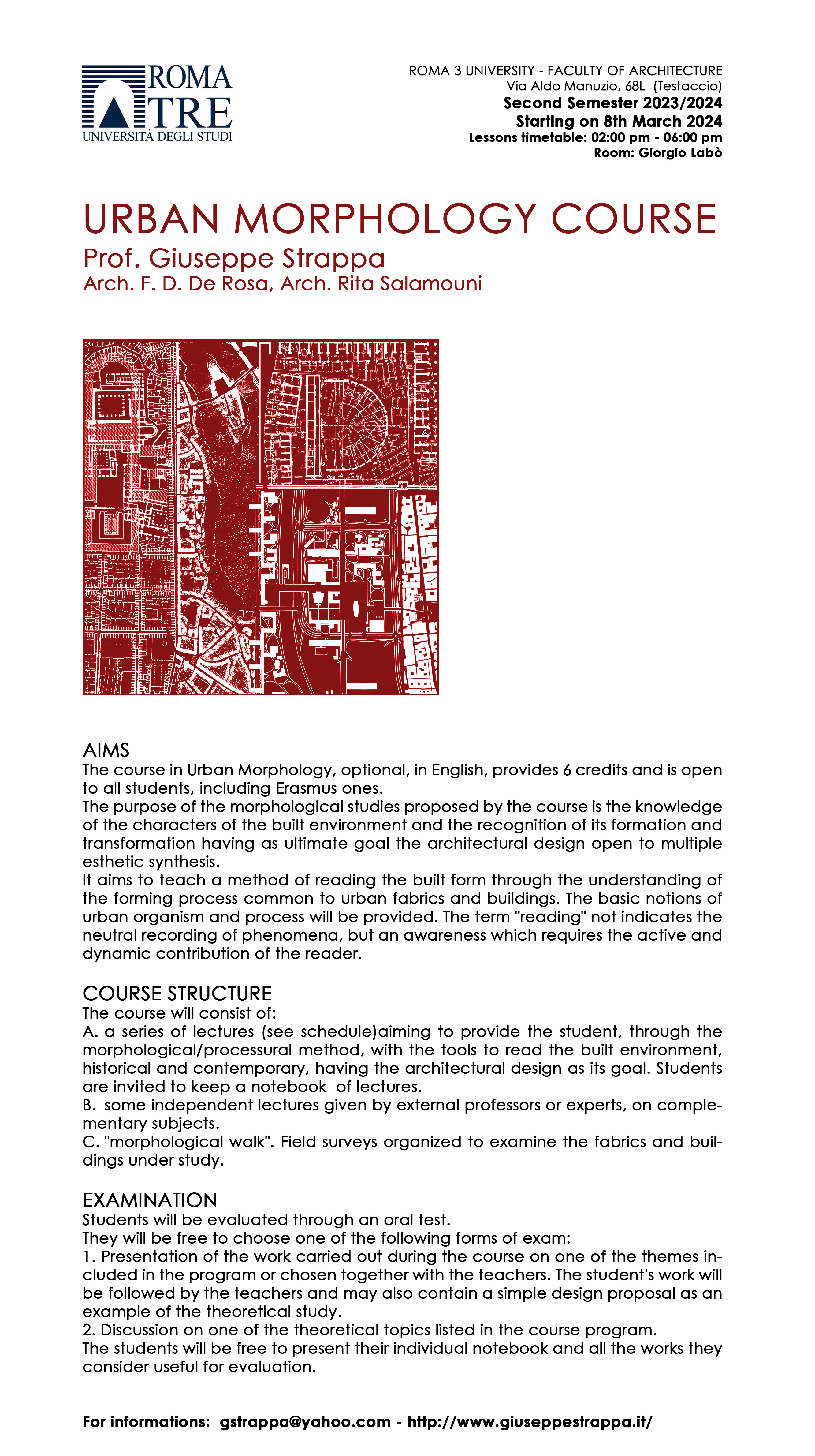
URBAN MORPHOLOGY COURSE 2024

               APRI LA LOCANDINA  def. corso roma3 2024

SCHEDULE – CONTENTS OF THE LECTURES AND ACTIVITIES

 8h March – Introduction. Meaning and utility of Urban Morphology for the contemporary architecture.

15h March – Course organization. Schedule. Presentation of the program. Student registration. Guest lecturer MARTIN  EBERT  Between revolution and reform

22h March  Base building: base elements: notion, forming process and relationship with urban pre-existence – Ghetto cartography – groups forming (max. 4 students). classroom exercise

29h March  Matter Material: notion, transformation process, contemporary condition. Classroom work.  design exsercise

5h April  Fabric -Urban Organism – Substrata: the physical form of the city:  notion, forming process; contemporary condition – classroom exercise. Guest lecturer  ATTILIO PETRUCCIOLI  The interpretation of urban fabrics in the eastern city.

12h April  Special building: forming process and contemporary examples. Architectural knotting: historic notion and transition to modernity. classroom exercise

 19h April  . Field Survey: on base building topics (F. De Rosa, R. Salamouni)

26h April  Territory: notion, forming process and contemporary condition. classroom exercise

 3h Maj  Field Survey on special  building topics.  classroom exercise

10h Maj  At the roots of architectural composition: the notions of assembly and aggregation in history and in the contemporary condition.  classroom exercise

17h Maj  Roman modern architecture. specific features of modern Roman architecture from U.M point of view. Guest lecturers R.CAPOZZI, F. VISCONTI  Space and Form in the architecture of Louis Kahn

 24h Maj  book presentation (?) –  Conclusion. and questions about the examination programme (unclear parts of the lectures, supplementary topics, etc.) Student opinions and suggestions.

31st May  Short recap/summary of the course main topics (for the examination)  Short (2 hours) pre-examination test (optional)

Base texts online

  1. Strappa, L’architettura come processo, Franco Angeli, Milano 2015

The main chapters translated into English can be found on the teacher’s website (https://www.giuseppestrappa.it/) and are indicated below:

.            Notes on base buildinghttps://www.giuseppestrappa.it/?p=8400

.           The aggregation process and the form of the fabric, https://www.giuseppestrappa.it/?p=8380

.           Special nodal building, https://www.giuseppestrappa.it/?p=8159

.           Architectural knotting, https://www.giuseppestrappa.it/?p=8414

.           G. Strappa, Territory as architecture, 2019 – https://www.giuseppestrappa.it/?p=8355

Base text in paper format

  1. Caniggia, G.L. Maffei, Interpreting basic building, Altralinea, Firenze 2017
  2. Scardigno, N , Salamouni, R, Architecture in the making, Conversation with Giuseppe Strappa on urban morphology and design, Springer, Cham, 2024 (In the process of publication)


U+D n.20 TERRITORIO E CITTA’ – Editoriale

 Leggere il territorio.
Prendersi cura del territorio

Giuseppe Strappa

Una riflessione responsabile sulla trasformazione della nozione di territorio, credo, dovrebbe oggi tener conto due condizioni fondamentali.
La prima è la percezione sincronica che abbiamo del mondo costruito, in un contesto dominato dal presente. Percorsi, insediamenti, aree produttive, fanno tutti parte di uno stesso ambiente contemporaneo, le cui ragioni formative sembrano appartenere a un insieme di problemi distanti dalla vita reale. In questa compresenza di tutte le cose, le città coesistono, indistinte, col loro hinterland, col territorio che le circonda e che dovrebbe spiegarle, con le infrastrutture che le annodano.
Sulla constatazione che città e territorio siano, di fatto, la stessa cosa si è sviluppata un’intera letteratura, almeno a partire dall’idea proposta da La città in estensione di Giuseppe Samonà (1976). Punto di vista allora senz’altro utile, ma oggi inattuale per non tener conto della progressiva urbanizzazione di ogni area del nostro pianeta (con le relative polarizzazioni e marginalizzazioni) che forse è la vera chiave di lettura di un fenomeno di concentrazione che sembra contraddire i miti della delocalizzazione in un nuovo universo digitale.
Soprattutto, questa nuova visione sincronica della realtà costruita sembra del tutto estranea alla lettura del divenire storico del territorio. Lettura, ritengo, fondamentale e non eludibile, a partire dalla considerazione elementare che ogni fenomeno si spiega con la sua origine e trasformazione: prima l’uomo si
muove, cammina, migra, traversa crinali e fondovalle di luoghi dei quali acquista coscienza attraverso la reiterazione dei percorsi, quindi si ferma, stabilisce le aree di pertinenza di una comunità (aree culturali) e costruisce gli insediamenti.

Continua a leggere:

U+D 20 Editoriale Strappa


Call U+D n 20 – Territorio e Disegno urbano – Territory and Urban Design

U+D Urban form and design | n.20 2023  call
Territorio e Disegno urbano
Strumenti, studi, progetti
Scadenza: 1 settembre 2023
Pubblicazione: entro dicembre 2023

Territory and Urban Design
Tools, studies , design
Deadline: September 1 st 2023
Publication: December 2023

U+D Call n 20 ITA ENG (2)

Sotto la spinta di un’ urbanizzazione crescente, sono stati cancellati i confini tra la città e l’area vasta che ad essa fa riferimento, stabilendo inediti legami tra paesaggi naturali, urbani e metropolitani . Nella condizione contemporanea, questi legami sono leggibili come complessa rete di relazioni fisiche, (naturali e antropiche), e immateriali che hanno perso i tradizionali caratteri di organicità del territorio storico
La città contemporanea va ormai pensata all’interno di un nuovo paradigma dinamico: come momento di provvisorio equilibrio nel divenire d i parti e sezioni di scambio che ne ridefiniscono costantemente l’ assetto morfologico.
Il territorio, a sua volta, è oggi costellato d i piccoli centri che stanno affrontando a volte fasi di abbandono, ma anche di una inedita trasformazione e nuovi sviluppi nel rapporto tra il paesaggio agrario e ciò che resta del paesaggio naturale, facendo pensare a una possibile, originale organicità futura……

CONTINUA A LEGGERE

U+D Call n 20 ITA ENG (2)