Tag Archives: Roma Tre
Costruire il patrimonio Presentazione dei numeri 21 e 22/23 della rivista U+D

ROMA TRE Dottorato di ricerca Architettura: innovazione e patrimonio
Costruire il patrimonio.
Presentazione dei numeri 21 e 22/23 della rivista U+D
giovedì 18 giugno 2026
ore 17:00
Aula Musmeci Ex Mattatoio di Testaccio
Largo G.B. Marzi n.10, Roma
————————————————————–
Introduce
Luigi Franciosini
Il contributo di U+D agli studi sul patrimonio
Giuseppe Strappa Dipartimento di Architettura – Università degli Studi Roma Tre
Il patrimonio: dai frammenti al tutto
Paolo Carafa
Dipartimento di Scienze dell’Antichità – Sapienza Università di Roma
Abitare l’archeologia
Matteo Ieva
Dipartimento di Architettura, Costruzione e Design – Politecnico di Bari
Patrimoni e progetto
Nicola Scardigno
Dipartimento di Architettura, Costruzione e Design – Politecnico di Bari
————————————————
Ex Mattatoio di Testaccio
Largo G.B. Marzi n.10, Roma
giovedì 18 giugno 2026
ore 17:00
Aula Musmeci
07_VOCI DAL PATRIMONIO_18 giugno_blu
“La Repubblica, recita l’art. 9 della Costituzione, tutela inoltre il paesaggio e il patrimonio storico e artistico della Nazione “anche nell’interesse delle future generazioni”. Affermazione solo apparentemente scontata. Essa ci dice che l’idea di patrimonio culturale é anche il filo rosso che tiene unite nella memoria le vicende della storia, le sue tracce materiali e immateriali alle quali viene attribuito particolare valore, dando loro senso e continuità. Ma, nei suoi termini generali, esso costituisce soprattutto una scelta e un progetto. Contiene un’idea di futuro. Non tutto quello che abbiamo ereditato dal passato è, infatti, patrimonio culturale. Lo è, per definizione, solo quello cui attribuiamo valore, quello che contiene la qualità di rappresentare una comunità. Ne deriva che esso dovrebbe essere, oggi, non lascito inerte ma azione, implicando, come ogni progetto, un fine e una politica capace di trasformarlo in realtà. L’idea di patrimonio non è scindibile, in altri termini, da una visione generale che quelle scelte spieghi, che dimostri perché ad esempio, in un monumento siano più importanti i sostrati antichi, come si riteneva in molti restauri degli anni ’20, delle stratificazioni che li hanno trasformati, nella materia e nel significato, nel corso dei secoli. La nozione stessa eredità storica, il processo delle sue mutazioni nel corso del tempo, le sue connessioni con i valori in trasformazione che l’hanno generata, é essa stessa un prezioso lascito immateriale.
Il patrimonio, inteso nel suo senso generale di coscienza dell’insieme dei beni che una comunità possiede, é anche una grande sintesi che da significati sempre nuovi a fenomeni culturali formatisi, nel loro divenire storico, da un insieme di differenze.
Esso è, per questo, anche la trasmissione di un’impronta, un’identità lasciata anche a chi non la vuole o ad essa si ribella. Come nel racconto autobiografico di Philip Roth (Patrimonio, una storia vera, 1997) in cui l’autore accompagna il padre malato nel suo cammino estremo verso la morte e si accorge lentamente che la distanza che aveva cercato di mettere tra sé e il genitore si accorcia, che quello che rimane in eredità, nel sostrato della Newark ebraica di quegli anni, è una comune identità che, a lungo respinta, diviene ora una involontaria e immeritata rigenerazione, un lascito nel senso più pieno.
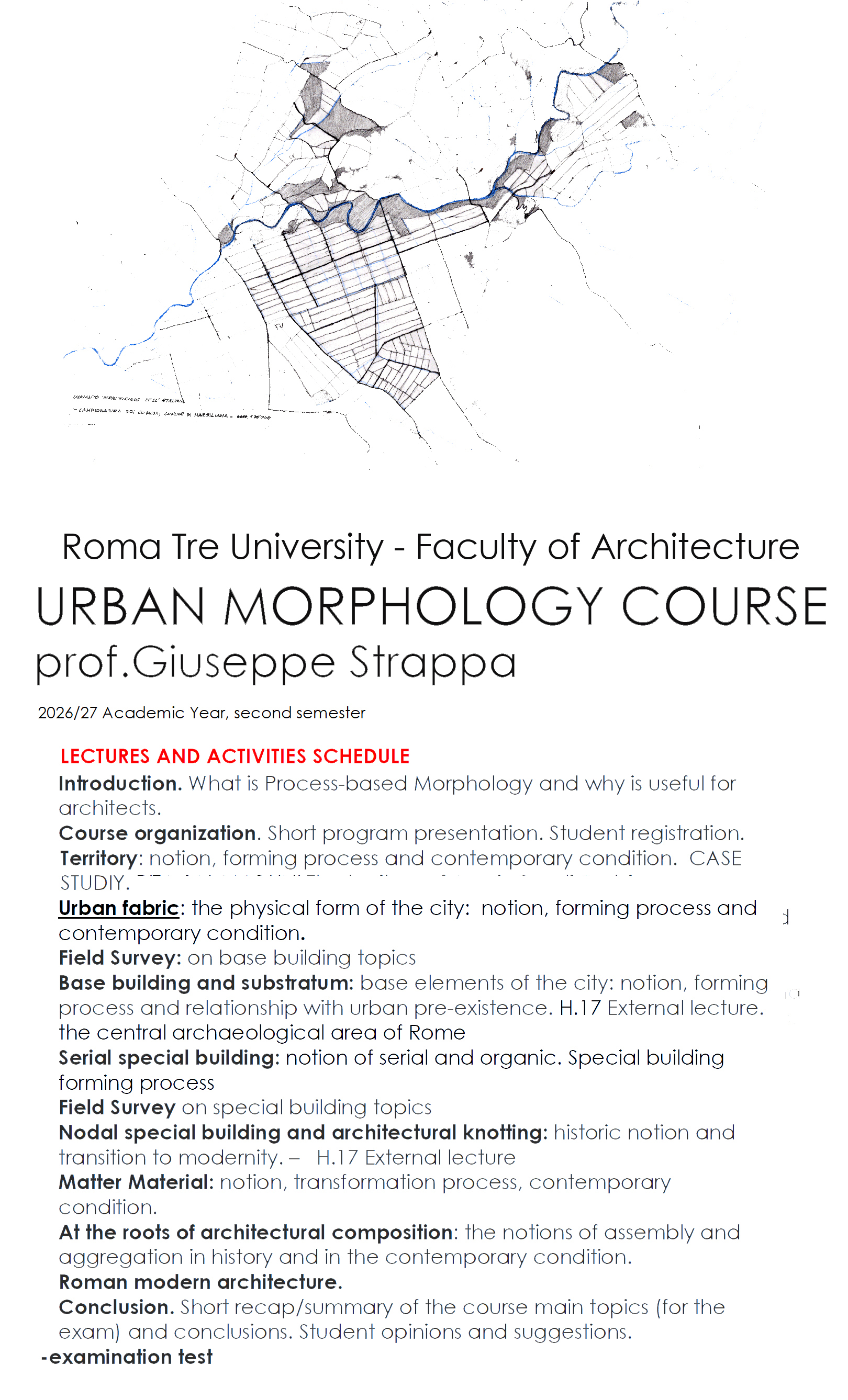
Urban Morphology Course – 2025/26 Prof. Giuseppe Strappa – Arch. Rita Salamouni – TERRITORY IS ARCHITECTURE

URBAN MORPHOLOGY COURSE- 2025/26 ROMA TRE UNIVERSITY

ROMA 3 UNIVERSITY- FACULTY OF ARCHITECTURE – Second semester 2025/2026
URBAN MORPHOLOGY COURSE
| STARTING on 6th MARCH 2025 – h 14.30, Room Nicolini
for information: gstrappa@yahoo.com – https://www.giuseppestrappa.it/ |
prof. Giuseppe Strappa – arch. Rita Salamouni
AIMS OF PROCESS-BASED MORPHOLOGY COURSE
The course in UM, optional, in English, provides 6 credits and is open to all students, including Erasmus ones. The purpose of the process-based morphological studies proposed by the course, is the knowledge of the characters of the built environment and the recognition of its formation and transformation having as ultimate goal the architectural design open to multiple estetic synthesis.It aims to teach a method of reading the physical form of the city through the understanding of the forming process common to urban fabrics and buildings, The term “reading” not indicaes the neutral recording of phenomena, but an awareness which requires the active and dynamic contribution of the reader. The basic notions of urban organism and forming process will be provided.
COURSE STRUCTURE
The course will consist of:
- a series of lectures (see schedule)aiming to provide the student, through the morphological/processural method, with the tools to read the built environment, historical and contemporary, having the architectural design as its goal.
- some lectures given by external professors or experts, on complementary subjects.
- “morphological walk”. Field surveys organized to examine the fabrics and buildings under study.
EXAMINATION
Students will be evaluated trough an oral test trough a presentation of the work carried out during the course on one of the themes included in the program or chosen together with the teachers. The student’s work may also contain a simple design proposal as an example of the theoretical study.The students will be free also to present their individual notebook and all the works they consider useful for evaluation.
COURSE REFERENCES
Base text in paper format
- Salamouni, N. Scardigno, G.Strappa, Architecture in Becoming. Dialogues in Urban Morphology and Design. Springer, 2025
Base texts online
- Strappa, L’architettura come processo, Franco Angeli, Milano 2015
The main chapters translated into English can be found on the teacher’s website (https://www.giuseppestrappa.it/) and are indicated below:
. Notes on base building – https://www.giuseppestrappa.it/?p=8400
. Learned language/everyday language
. The aggregation process and the form of the fabric, https://www.giuseppestrappa.it/?p=8380
. Special nodal building, https://www.giuseppestrappa.it/?p=8159
. Architectural knotting, https://www.giuseppestrappa.it/?p=8414
. G. Strappa, Territory as architecture, 2019 – https://www.giuseppestrappa.it/?p=8355
Martin Ebert – Between Revolution and reform – UM lecture
