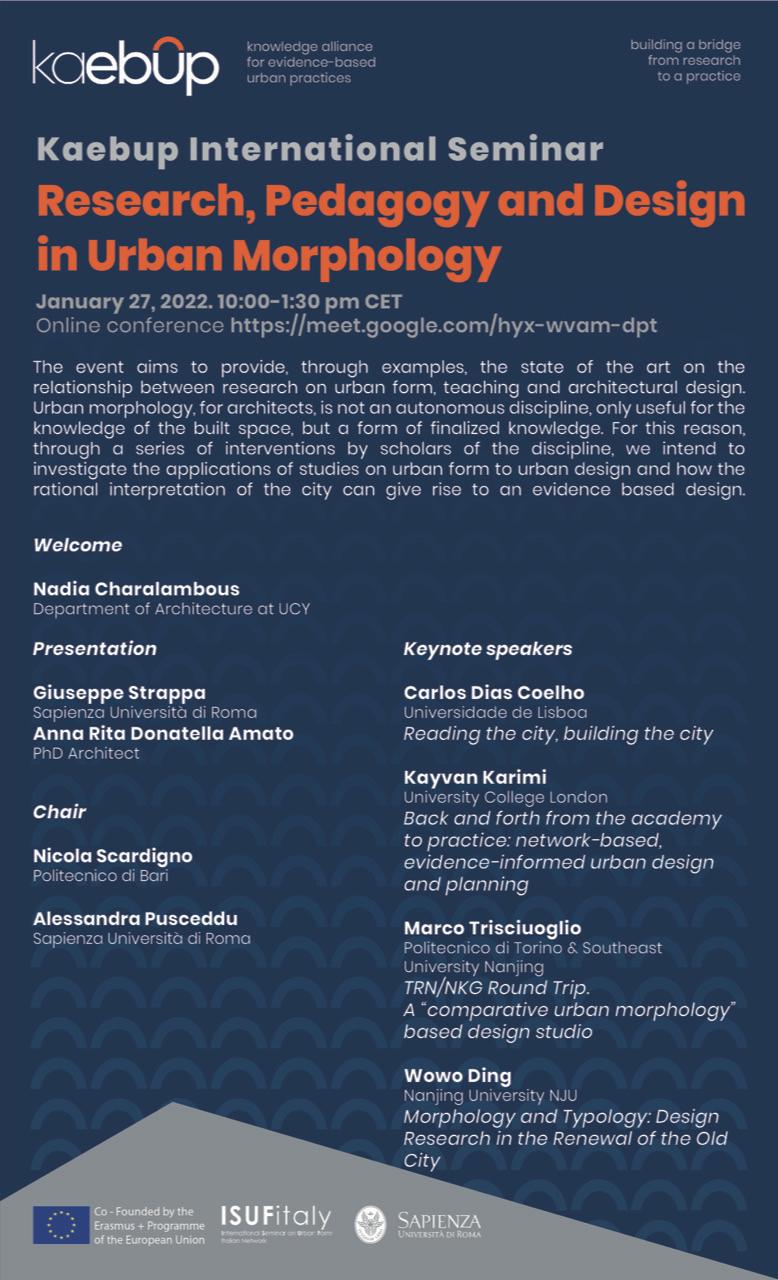
Tag Archives: Nicola Scardigno

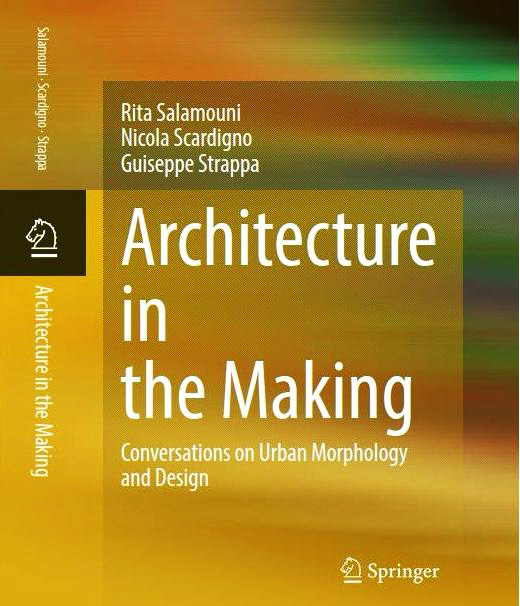
R. Salamouni, N. Scardigno, G. Strappa Architecture in the Making. Conversations on Urban Morphology and Design

The book “Architecture in the Making” has finally been published by Springer. A long conversation with Rita Salamouni and Nicola Scardigno on architectural form. Thanks to Franco Purini and Joerge Gleiter for the beautiful introductions and to Matteo Ieva for the insightful afterword.

TABLE OF CONTENTS

Foreword

A treatise in form of a dialogue Franco Purini

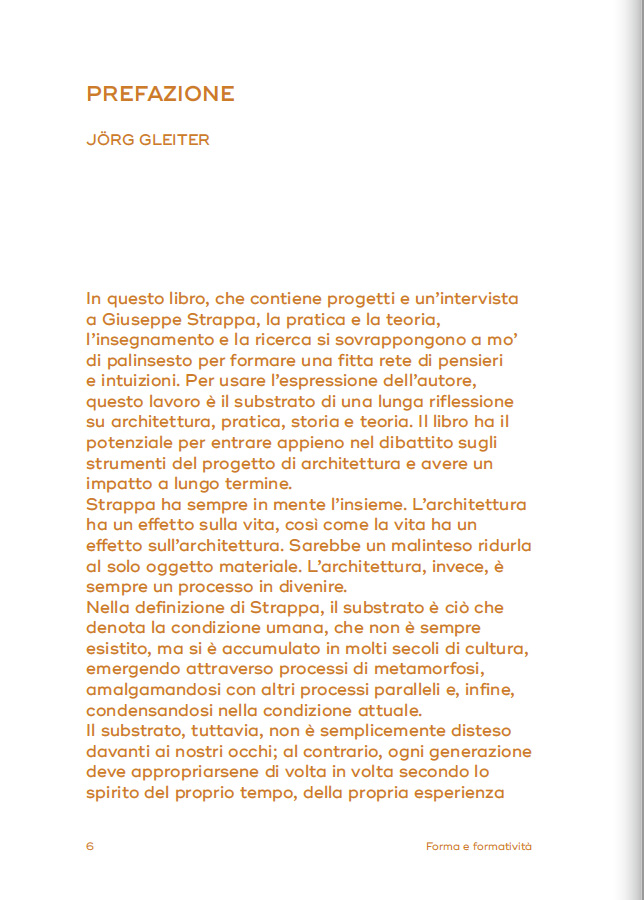
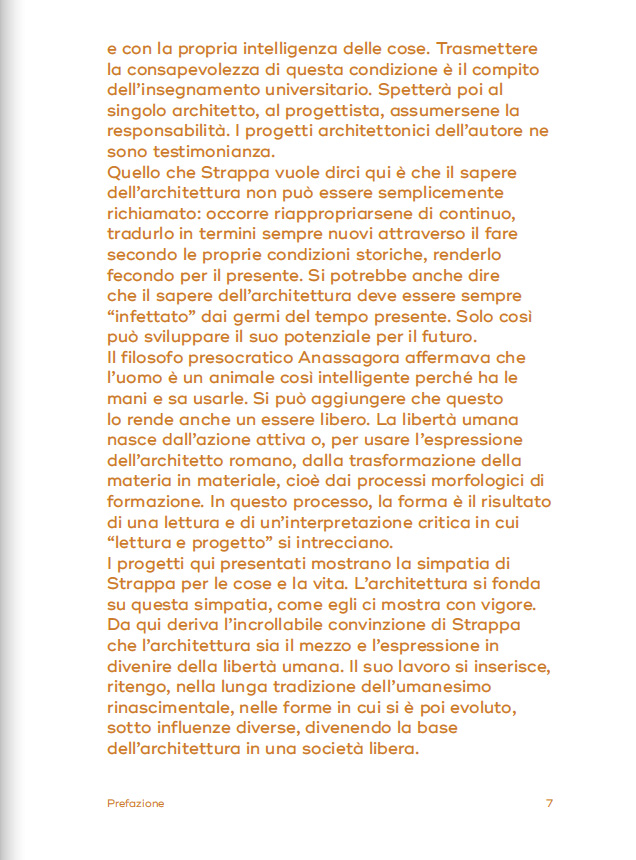
Architecture as medium and expression of human freedomJörg Gleiter

CONVERSATIONS WITH GIUSEPPE STRAPPA

  • Introduction

Space or art of Delimitation – Nicola Scardigno

Reading the Territory – Rita Salamouni

  • Method
  • Form
  • Organism
  • Territory
  • Expression
  • Didactic
  • Contemporary condition

Afterword

Poetics of the era and formativity of architecture – Matteo Ieva

——————————————-

Chapter 2
Method

N.S. I’d like to start our conversation by talking about the relationship between reading and designing, one of the central themes of your way of understanding the work of an architect.
In one of your writings you define the technique of reading as the “art of the possible.”
By emphasizing this relationship, you seem to recognize in the use of reading the ability to reveal and interpret the aptitude for transformation of the built environment. In other words, the reading would coincide, somehow, with the project itself.
My question is the following: if the project does not derive from, but coincides with the reading, could it not constitute a limit on the designer’s freedom, forcing him to follow a process that will end up imposing its choices?
Could you tell us more about this aspect of your working method, quite unusual in a context in which the center of the architectural project seems to be creativity and invention? In other words, how does the individual judgment of the designer intervene? That same judgment which in your method, in my understanding, tends to manifest itself as a “critical distance” from the reality that is offered to the designer.
G.S. Let me begin with a brief premise. I believe that the architect, in the crisis conditions which we are experiencing, cannot but be biased and propose the truth he believes in. At the same time, he is aware that in the contemporary context, when the unity of things has been lost, this truth can only be partial and that there are many
others.
In other words, the architect should possess his own vision of the built world in which he places and gives meaning to things. This vision should not only contain the perception of what surrounds us. It should also contain the myth and utopia that allows us to detach ourselves from the daily contingent and explore new territories.
However, within this idea of the world we inhabit, expressing ourselves based on a personal point of view is not enough.
We need to scrutinize with the reason the process by which the built landscape was formed and could be transformed. This could be done through a reading that will inevitably contain the result of a pre formed vision. In fact, every reading in architecture is critical and contains the aptitude of the object to be interpreted. It also has the active intentionality of the reading subject.We must know that there are many truths, but that we can only own one.
Moreover, the partiality of which I am speaking is also concentration. While being conscious of the general context in which we operate, we should, critically, neglect some elements, so that others appear with the utmost clarity.
On the contrary, it seems to me that the architect nowadays is lost in  an attempt to understand and share everything, ending up adapting to all the requests, which are those of the market. The proof is that today architecture criticism doesn’t seem to exist except as an organization of consensus for media circuits. In fact, the general condition of architectural culture is still that of postmodern relativism. It is immersed in the late romantic myth of subjective expression and creativity.
Let me explain myself better.
Of course, the architect’s task is to grasp the instances of his own time. This should not consist in “recording” the contemporary condition. Instead, it should be a biased oriented intelligence that seeks order in the built world by stitching together its scattered details according to its own unified design thinking, not embedded in the present.
Architecture understands the world by turning to the history and lives oriented to the future it designs. The present is the current condition that we need to change.
Many of the best-known works, which are supposed to represent the image of our time, seem to derive, rather, from an effort of mimesis, and are often a parody of the contemporary world. They constitute, in fact, the product of an acceptance proposed as inevitable, the adaptation to a condition of irresponsibility. Evidence of this disengagement is the obvious decadence of the monument theme, of the celebration of institutions as the result of shared civil values whose last true interpreter was the epic poetry of Louis Kahn.
But let’s start, as you suggest, from the most personal and difficult truth to communicate. Let’s talk about the identity between reading and design. I believe that things are exactly the way you put and describe them: this coincidence between two aspects of design work, which are generally identified as successive stages of a process, is a different way of knowing the built world. It tries to grasp from the object of study, not only the real characters, but, at the same time, the aptitude for its transformation. It contains a hope, a desire.
On the one hand, reading is, for the architect, a critical knowledge and cannot be neutral. It is purposive and contains an evaluation and a distinction. It does not precede the project; it builds it, informs it, indicates its possible future form. I understand the difficulty in accepting these considerations in a discipline in which the reading
(historical, topographical,morphological) usually precedes the design act in an oftenritual way. In fact, reading the built landscape that surrounds us is not a description through which we state the terms of the problem. It is the substance of the project itself. On the other hand, the project is a general form of knowledge, a reading. As architects, we know the world around us through the project which, in some way, contains our universe, our way of being on Earth. It encloses a “pre-form.” I believe that this notion explains many things: the pre-form is the condition within which we read the built environment, the substratum of our consciousness that makes every
reading, and therefore every project, individual and non-repeatable.
This observation runs through the entire history of Western thought in various ways: from Aristotle’s statement where the interpreter cannot “prescind from himself” up to the “pre comprehension” of Hans Georg Gadamer (the a priori meaning we attribute to things when we need to recognize them).
Hence the architecture I am thinking of is a “formative” architecture, based on formed and forming. Therefore, the design activity is a circular process. It begins with reality: in the infinite possibilities of change in the existing reality, we look for some common aspects, the general in the particular. Through the study and comparison of the phenomena, we abstract some (few) generative rules. We trace a finite series of principles capable of generating an infinite series of forms (not all necessarily realized or achievable).
We then go back to reality, which only accepts those forms congruent with the real context, and whose number is further reduced when the responsibility of the designer intervenes with his understanding of economic and social needs.
Moreover, when he operates, the architect’s aesthetic synthesis can only be personal, singular. Therefore, the general and common is “identified” and becomes unique, irreproducible and individual. In other words, I am convinced that our action should be placed in the great flow of transformations of the world we inhabit. We must seek the sympathy with things. In fact, for our small contribution to be useful to the transformation of the environment, it must contain a much distant and different way to design. This term has for me the literal meaning of inventing (from the Latin invenire, to meet), encountering new forms, in the study of the built universe, which may contain some fertile diversities or dissonances to cultivate.
Reading, as a critical representation of the builtworld, is also an individual attitude of the spirit. It is an art. As you said, it is the “art of the possible.” Understanding it as an opening toward the infinite possibilities that are offered to the way we perceive the world implies a study of the form (a morphology) that is anything but classificatory.
It should not be conducted with the tools of the entomologist, as if the universe built by man was governed by rigid and inescapable laws.
It is, on the contrary, a procedure that I would call “artistic.”
According to a late Romantic idea still widely practiced today, is artistic the manifestation of a feeling as an individual. However, what I mean by art is, instead, in the classical sense, the rule that presides over the act of transforming things, the τέχνη.
The project consists, as I see it, in the last stage of a reading process, the one where what is ends and begins what could be and what you want it to be. It is evident that giving form to the aesthetic synthesis that transcends construction is a task that involves the architect’s individual nature, his choices, and his poetic way
(the personal truth of meanings) of seeing things. But it also has to do with his responsibility, setting boundaries to his artistic freedom. In fact, we need to understand what this term means in architecture. The writer’s freedom is not to use words freely, without respecting the structure of the language (without which there is no communication) but, on the contrary, to know it so well as not to feel its burden in writing. And the same applies to the musician. Why shouldn’t it apply to construction?
Architecture, understood as a discipline, has its own character. It is a civil art, aimed at satisfying the need to represent a social context. It is an “inevitable” art: we may not see a paintingwe don’t like but we cannot avoid the reality of an architecture, of an urban space. This is why we are not allowed to guess through perception: we are required to deduce through reason.
This way of seeing things gives a different meaning to some established axioms.
On the basis of what I maintain, for example, the masterpiece is not the work that owes its value to the fact that it is totally new that it contrasts with what has already been produced. Themasterpiece is the individual (individual!) synthesis of a forming process, the one that expresses, in the fullest form, the spirit of a civil community in time and space. It is formed through shared principles; the unitary spirit that binds the dispersed detail to the totality of the organism.
A masterpiece is the work (very rare) that looks at the past with new eyes, concludes a process, and sows the seed to start a new one.
N.S. There is one aspect that is still not clear to me. I would like to understand whether in your work the reading of the built reality offered to the designer represents a “limit” or a “boundary.” That is, whether it constitutes an instrument of almost absolute value, by which the design outcome is strongly conditioned, or whether it is the center of a method that collaborates to the designer’s work by defining its contours open to multiple interpretations, establishing a “critical distance” with the object of study.
G.S. I believe that the essence of the architect’s work consists in the criticalreading of the built reality open to different design outcomes and to infinite aesthetic syntheses. As architects, we operate on the existing built landscape through “preforms.”
They are different for each of one us and constitute the individual condition of our consciousness through which we look at the world.
Let me start with a consideration on the contemporary meaning of what I am saying. In the crisis we are facing, I realized how statements like the ones I made may seem, inmanyways, out of date. This consideration is very comforting tome because I almost agree with nothing in what is being done in architecture today, such as the aestheticizing drift in which even ethics has become an ingredient of the spectacle, of the media circus that turns everything into goods.
“More ethics and less aesthetic” is a successful slogan, fed to a society of consumers, in which no one really believes. I therefore accept the outdatedness ofmy research and consider it a resource. Although there is no doubt that it is a component of it, the essence of architecture is not a subjective expression, communication or personal commentary on reality: architecture is reality.
I don’t know if this way of seeing things can be defined, as you said, as “critical distance.” Certainly, by the very nature of our work, the relationship with the matter to be transformed tends to be passionate and emotional. But, according to a still very current romantic tradition, it threatens to overlap with the civil role that the architect has in our society.
The antidote against the intrusiveness of emotion is dialectics, which forces the thought to alienate itself from its own beliefs, to put a distance between the author and what he produces, allowing ideas, in a continuous becoming, not to stiffen.
In this sense, the built reality as well as the landscape it offers to our perception, do not constitute a limit at all. They do not dictate laws or rules. According to Kant, the limit presupposes “space that is beyond,” which contains a whole world with its own order. However, the world around us is an open whole, where everything overlaps and coexists. Reading and designing, with the difficulties that this action entails, mean precisely this: unraveling the complexity of the whole by not isolating the part, understanding how the elements of the built landscape that surround us are complementary.
This allows us to not identify ourselves with the object of our study. I would say that the designer’s effort should tend to look at the built world with the detachment that allows him or her to understand places as a common good, in their historical development, with a kind of “critical empathy.”
This will allow us to overcome the pure perception of forms.
The form, which is at the heart of our craft, is not the surface that we grasp of things: it is the way in which a structure gives itself to our eyes, how we know, individually, even what we do not see directly. The seduction of appearance is one of
the great dangers of our work. That white house we see is part of a group of houses. But the white color is the visible property that we all perceive through the optic nerve.
However, the way in which it is part of a whole, an element of a society of houses (that is, the links that bind the objects), is not visible. It derives from experience, knowledge and reflection, that is, from the specific culture of the observing subject.
This necessary understanding of things should be clearly highlighted and does not necessarily mean, in the project, affinity: it can be translated into opposition, if circumstances require it. But even fractures and tears, when they are real, express a procedural drama, the extreme of sudden transformation, not the exhibition of the author’s feelings. I am thinking of the many centerless revolutions of contemporary production, the “discovery” of the theme of fragmentation of the contemporary city which has become a true literary genre.
At the opposite extreme, we find the absence of transformation, the identification of intentionwith what exists, itself part of a process. This is the most difficult reading. Perhaps the architect should learn that, at times, critically reading a place can also mean carrying out wise maintenance while basically leaving what has already its own function, beauty, meaning.
A few days ago, my friend Vincenzo Latina presented on Facebook the case of the splendid Baroque church of San Gennaro located in Capodimonte, Naples “before and after the care of the Archistar Santiago Calatrava” who turned it into a kind of seaside disco.
An extreme example, among many, which indicates how much architecture is a risky job, and often induces to the invasion of places. OurMinister ofCulture rushed to incautiously declare that “this experience,which mixes contemporary and baroque art in an unprecedented way, will have to show us the way.” Capodimonte church remains one of themany cases in which the collective feeling of inhabitants is trampled on, by the narcissism of the architect. How many buildings, historical and not, have in fact been turned into matter at the disposal of the designer’s ego, receiving the concordant consent of the “critics?”
Was there really a need to invade the magical territory of the Domus Aurea in Rome by a spectacular up-to-date intervention?Wasn’t the space in the SalaOttagona evocative enough, with all due respect to the media success of the studio that designed the work?
Perhaps it is necessary to explain that restoration is already a project and a transformation. And that, sometimes, even less is needed. I think we should rediscover the fascination and usefulness of the gaze that contemplates the reading of things in which no aptitude for transformation is recognized. “Is it really necessary to build a new public granary”—wrote Confucius 2500 years ago—“when the old one is still good and the new one will cost people a lot of sweat?” That granary actually possessed, like all things, not only a utility, but also, a magnificence of its own. The problem was that many, noted the master, did not know how to read it.

ARCHITECTURE IN THE MAKING

RITA SALAMOUNI

NICOLA SCARDIGNO

GIUSEPPE STRAPPA

ARCHITECTURE IN THE MAKING

Conversations on Urban Morphology and Design

Foreword by Franco Purini and Jörg Gleiter

Afterword by Matteo Ieva

SPRINGER 2025
 

FRANCO PURINI

A treatise in the form of a dialogue

When compared to the conversations one can see and hear on television programmes, the written interviews found in newspapers, magazines and books remain in the mind in a lasting way.  In fact, for many years now, the interview has become a significant, complex and widespread literary form. What is asked and the answers to the questions imprint themselves on the read­ing, forming a permanent message.

There are various ways of interviewing. One can choose the theme of biography, which recounts a life in its varied unfolding. One can ask about one’s opinions on accidental events, mistakes or posi­tive things one has done. Sometimes it is mainly asked about the context in which one lived and the influence it had on us. In other conversa­tions, the main topic is the relationship with knowledge other than the one we have chosen and cultivated. A description of our qualities is also frequent in interviews. Finally, they can have, as the focus of the discussion, the expres­sion of a theory. These are, in my opinion, the most culturally incisive ideas that presuppose communication skills as well as the ability to ex­pound one’s beliefs.

It must also be said that the difference between interview and dialogue has long since disap­peared. The “Interviste impossibili” (impossi­ble interviews) of the 1970s, together with the “Alle otto della sera” (At eight o’clock in the evening) conversations in the following period, have made the talk of two people a much more cultured discursive sphere, in which dialogue – a term that indicates a more authentic and profound encounter than a simple exchange of news and opinions – often deals with problems, orders and reasoning that go beyond entertain­ment to take the form of real lectures. Obviously, the different forms of the interview depend, to be understood as a whole, on the ques­tions asked. Those who formulate them must not only be clear and precise but also capable, like a director, of conducting the interview with great rigour. Nicola Scardigno’s and Rita Salamouni’s work in their dialogues with Giuseppe Strappa is, from the point of view of content and the rhythm of the conversation, exemplary. What is asked in the questions proposed is a progressive narrative in which the individuality of who replies gives way to a system of linked notions defining the con­sequential level of choices. The set of answers to the questions, posed with excellent logic by Giuseppe Strappa’s interlocutor, outlines a vast, precise and inspired conceptual framework. In short, this book is nothing other than a treatise on architecture proposed and articulated with wisdom and a mathematical progression, the re­sult of the long and active teaching of the Roman teacher in the capital, in Bari and in many other cities, where he brought his fruitful knowl­edge. His treatise recalls historical Platonic dia­logues, evokes Paul Valéry’s “Eupalino”, recalls the precious syntheses of Le Corbusier and the compositional magic of Mies van der Rohe, but above all follows the theoretical path that goes from Saverio Muratori to Gianfranco Caniggia.

All this to define a system of statements that do not so much confirm previous references, as list a series of current, operationally precise, ideas produced by an assiduous study of the changes that morphology and typology have undergone in recent decades.

Giuseppe Strappa, therefore, does not validate the notions of typology and morphology pres­ent in the conceptions of Saverio Muratori and Gianfranco Caniggia, but identifies a new path towards a necessary innovation of these found­ing categories.

TABLE OF CONTENTS

Foreword

A treatise in form of a dialogue Franco Purini

Architecture as medium and expression of human freedomJörg Gleiter

CONVERSATIONS WITH GIUSEPPE STRAPPA

  • Introduction

Space or art of Delimitation – Nicola Scardigno

Reading the Territory – Rita Salamouni

  • Method
  • Form
  • Organism
  • Territory
  • Expression
  • Didactic
  • Contemporary condition

Afterword

Poetics of the era and formativity of architecture – Matteo Ieva
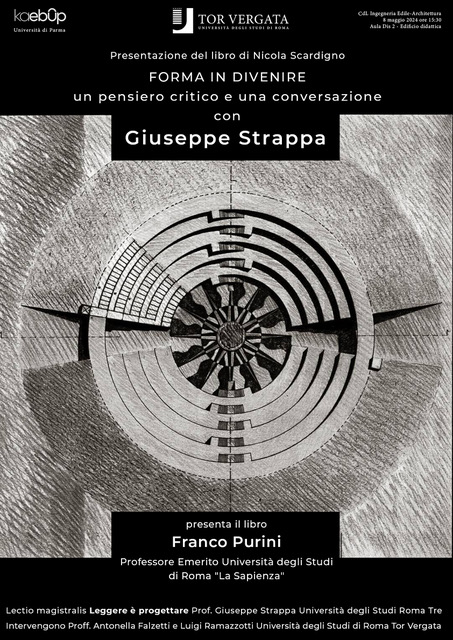
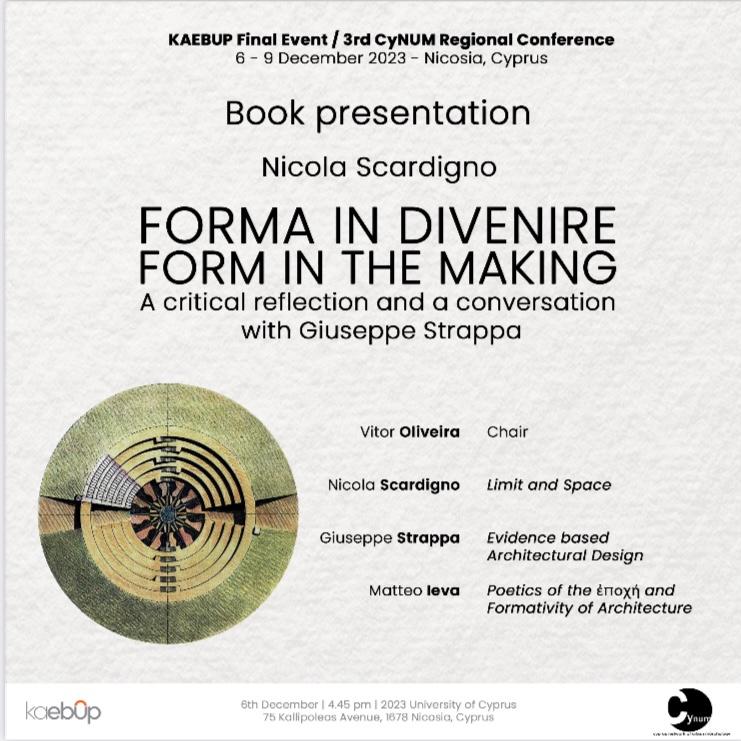
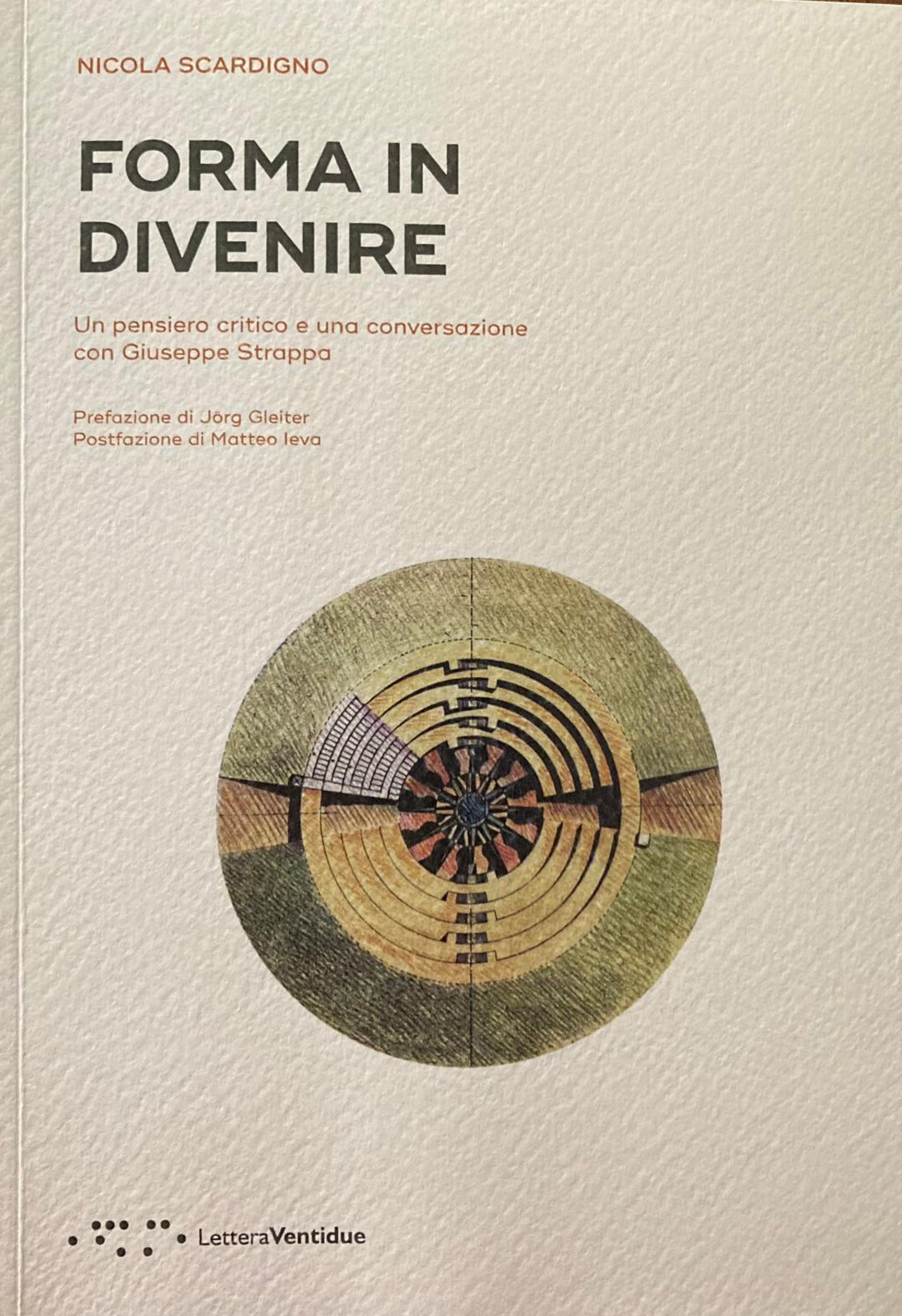
Nicola Scardigno – Forma in divenire


NICOLA SCARDIGNO

FORMA IN  DIVENIRE

Un pensiero critico e una conversazione
con Giuseppe Strappa

Prefazione di Jörg Gleiter
Postfazione di Matteo Ieva

INDICE
PREFAZIONE di Jörg Gleiter
SPAZIO O ARTE DELLA DELIMITAZIONE
CONVERSAZIONE CON GIUSEPPE STRAPPA
Parte 1 – Il progetto come processo circolare
Parte 2 – Didattica come “Architettura insegnata”
GIUSEPPE STRAPPA: POETICA DELL’EPOCHÈ E
FORMATIVITÀ DELL’ARCHITETTURA
Postfazione di Matteo Ieva